LLM Guardrails Explained: A Practical 2026 Guide
Learn what LLM guardrails are, the main types that actually work, evaluation metrics, and a pharma-ready roadmap for safe, auditable AI in 2026.
LLM guardrails are a layered control system designed to ensure compliant and accurate AI-generated content, especially in regulated industries like pharma. They act across the content workflow—before, during, and after generation—to prevent issues such as unsupported claims, off-label framing, or the use of outdated sources, thereby enhancing the efficiency and trustworthiness of MLR reviews.
When does a draft fail MLR for the third time?
The third rejection usually feels unfair to the team that built the prompt. The draft was generated from the same source pack, the same indication brief, and the same writing template, yet the output still wandered. One draft hallucinates a precise benefit claim, the next softens it into “suggests potential,” and the reviewer still has to explain why the language crosses the line.
That's the core mistake many teams make. They treat guardrails as if they were a nicer prompt or a stricter content filter, when the actual failure happened across the whole request path, from source selection to output review. A system can be fluent and still be unfit for MLR because fluency doesn't prove traceability, approved scope, or audit readiness.
Where the failure really starts
The first weak point is usually the source layer. If the model can retrieve from a broad mix of drafts, slide decks, and old assets, it can borrow language that was fine for one use case and wrong for another. The second weak point is output enforcement, because a model can produce polished prose that still lacks a sentence-level reference or contains an unsupported inference.
Practical rule: if the reviewer is catching the same type of issue twice, the system is failing before the draft reaches human eyes.
That's why llm guardrails need to sit at multiple points, not just at the end. Policy constraints narrow the allowed topics, retrieval checks limit the source pool, prompt controls shape the model's behavior, output validators catch unsupported claims, and monitoring shows where the workflow keeps drifting. For pharma teams, the question isn't “Did the model write well?” It's “Did the system prevent a non-compliant draft from becoming review work?”
What do LLM guardrails mean in 2026?
In 2026, LLM guardrails are best understood as a layered control system, not a single product class. They protect the request before generation, during generation, after generation, and after deployment. That structure matters because regulated content fails in different ways at each stage.
Think of it the way clinicians think about safety controls. Some controls prevent harm before it starts, some detect risk in real time, and some create documentation so the event can be reviewed later. Guardrails work the same way in production AI, they're a discipline for reducing unsafe behavior, not a promise that the model will “just know better.”
Primary prevention, secondary detection, tertiary oversight
Primary prevention includes policy and prompt design. This defines approved audiences, disallowed claims, required tone, and the kinds of source material the model may use. If those instructions are vague, the model has too much room to improvise.
Secondary detection sits closer to the response. Retrieval checks, model-level constraints, and post-processing filters look for unsupported claims, policy drift, leakage, or malformed output. These controls are useful because they catch mistakes that slipped past the first layer, but they don't make the system immune to every bad prompt or adversarial input.
Tertiary oversight is monitoring and audit. Logging, review triggers, and traceability let you answer a question MLR always asks sooner or later, which draft used which source, who approved it, and what changed before publication. That's the layer buyers often skip when they think “guardrails” means “safe output.”
Guardrails aren't the same as prompt engineering. Prompt engineering tries to coax a better answer from the model. Guardrails define what the system is allowed to do, what evidence it can use, and what happens when it strays.
That distinction matters in pharma because a compliant-sounding sentence can still be wrong, and a wrong sentence can still be easy to approve if nobody can see the source trail. A real guardrail stack handles both the language and the governance burden.
What are the six core types of guardrails?
The easiest way to understand llm guardrails is to sort them by where they act in the workflow. Some control policy, some shape the model, and some inspect runtime behavior. If you only buy one category, you usually get the benefits of that category and the blind spots of all the others.

Policy and model controls
Policy guardrails encode the rules the business already knows. In pharma, that means approved indication scope, audience boundaries, brand language, and country or channel restrictions. They're good at stopping obvious out-of-scope requests, but they won't automatically catch a hallucinated citation or a subtle factual error.
Model-level guardrails change how the model behaves. Fine-tuning, constitutional methods, and refusal training help the model learn safer defaults, especially for repeated patterns. They're useful for consistent tone and refusal behavior, but they still can't guarantee that every output is grounded in the right evidence.
Runtime controls and oversight
Retrieval and augmentation guardrails shape what the model sees. Source whitelists, citation enforcement, and document-level constraints matter a lot for medical affairs because they reduce the chance that a draft borrows from the wrong corpus. If the wrong paper never enters context, the model can't rely on it.
Prompting guardrails live in the system prompt, structured output rules, and tool-use instructions. They're the fastest way to set boundaries, but they're also the easiest to bypass if they're the only line of defense.
Post-processing and output filters inspect completions. Regex checks, classifiers, and validators can block bad formatting, sensitive data, or unsupported language after the model responds. They're valuable, but they can't fix missing evidence inside the draft unless the workflow knows what evidence should have been there.
Monitoring guardrails watch the system over time. Logging, drift detection, and human review triggers help you see repeated failure modes, not just isolated ones.
| Guardrail Layer | False Positive Rate | Bypass Resistance | Latency Overhead | Evidence Coverage |
|---|---|---|---|---|
| Policy Guardrails | Can be low or high depending on rule specificity | Moderate when rules are explicit | Low to moderate | Low unless tied to sources |
| Model-Level Guardrails | Variable | Moderate for familiar behaviors | Moderate | Low to moderate |
| Retrieval Guardrails | Moderate if source sets are broad | Stronger against wrong-source use | Moderate | High for source-bound claims |
| Prompting Guardrails | Usually low overhead | Moderate | Low | Low unless paired with retrieval |
| Post-Processing Filters | Can over-block legitimate text | Moderate against simple violations | Low to moderate | Moderate for output validation |
| Monitoring Guardrails | Not a blocking layer | Indirect, through detection and response | Low at runtime, higher in review workflows | High for audit and traceability |
The point isn't that one layer wins. The point is that each layer covers a different failure mode, and pharma workflows need all of them to make MLR review efficient instead of repetitive.
How do guardrails perform when tested?
In practice, guardrails behave like trade-offs, not magic switches. A more aggressive filter catches more attacks, but it may also block legitimate content. A faster filter keeps the user experience smooth, but it can miss clever prompt variations. That tension shows up clearly in benchmark work on attack resistance, false positives, and latency.
The benchmark data in the brief makes the trade-off obvious. In one controlled test of 480 queries, NeMo-based guardrails achieved 0% bypass but had a 16.22% false-positive rate and about 1.5 s average latency, while Prompt Guard reduced latency to 2.50 ms but allowed 38.48% bypass with 3.60% false positives (benchmark details). Another evaluation across 15 defenses reported that on out-of-distribution data, Llama-Guard 2 reached 0.955 accuracy, 0.758 F1, 0.693 recall, and 0.836 precision, while Protect AI v2 showed 0.917 accuracy, 0.400 F1, 0.274 recall, and 0.741 precision (cross-defense benchmark).
What those numbers mean for pharma teams
High recall matters when you're trying to catch unsafe or unsupported content before it reaches MLR, but precision matters just as much because false alarms create reviewer fatigue. A guardrail that flags every third acceptable sentence doesn't save time, it shifts work. That's why accuracy alone is a bad headline metric for regulated publishing.
Retrieval-based checks and citation enforcement are usually the right place to focus when the content must be evidence-bound. They're designed to catch missing references, wrong-source usage, or unsupported claims, which is exactly the kind of failure that slows down medical review. Keyword filters and simple policy blocks are faster, but they're easier to sidestep with paraphrasing, so they can't carry the whole control load.
For teams comparing tools, this note on citation handling in AI outputs is useful because it separates source attribution from generic output filtering. That distinction matters when the reviewer needs to know not just whether a sentence sounds right, but where it came from.
How do guardrails perform in pharma content workflows?
The best way to judge a guardrail is to ask which failure it prevents before a reviewer has to. In pharma content, the failures repeat in recognizable patterns, and each one maps to a different control layer.

Three common failures and the controls that catch them
First, a mechanism-of-action paragraph states an efficacy claim without a citation. A sentence-level retrieval guardrail should block that draft before MLR sees it, because the claim isn't bound to an approved source. A generic content filter might miss the problem entirely if the wording sounds cautious.
Second, an HCP email starts drifting into off-label language because the model reused indication phrasing from another asset. Topic-scoped policy guardrails and corpus-restricted retrieval are the right controls here, since they prevent the system from crossing audience or indication boundaries in the first place.
Third, a congress summary cites a paper that was retracted months earlier. A freshness check on the source registry should surface that status change, because “present in the library” is not the same as “still valid for use.” MLR reviewers can catch that manually, but they shouldn't have to discover it after the draft is already polished.
Where humans still matter
Human review stays essential because guardrails don't decide business risk on their own. They can flag, block, or route, but they can't tell you whether a borderline claim deserves a country-specific exception or a rewrite. They also can't resolve ambiguity when a source is technically correct but operationally inappropriate for a given audience.
The strongest pattern is layered governance. Use guardrails to shrink the review surface, then let MLR focus on judgment calls instead of mechanical cleanup. That's where the productivity gain comes from, not from removing reviewers from the loop.
If your reviewers keep rewriting the same sentence, the system needs better evidence control, not a more persuasive prompt.
What is a pharma implementation roadmap for LLM guardrails?
Pharma teams usually get better results when they implement llm guardrails as a workflow, not as an isolated feature. The controls have to start with the source library and end with an audit trail, or the review burden just moves around instead of shrinking.

A six-stage path that matches MLR reality
1. Source ingestion. Bring in publications, internal documents, and approved references through versioned repositories. If the source isn't pinned, the draft can't be traced cleanly later.
2. Evidence tracking. Bind claims to sentence-level references at retrieval time, not after the fact. Tools like VeriCore fit naturally here, because the verification layer cross-references scientific entities against primary life sciences databases before generation.
3. Policy encoding. Translate indication scope, brand rules, and audience restrictions into machine-enforced constraints. This is the place to keep the model from wandering into unapproved territory.
4. MLR-ready review packs. Send reviewers the draft, diff trail, and attached references together. When the evidence is visible beside the language, reviewers spend less time reconstructing the chain of reasoning.
5. Pre-publish checks. Run output validators and safety filters on the final draft before it leaves the workflow. This catches formatting problems, unsupported claims, and other late-stage failures.
6. Audit and logging. Preserve traces, reviewer comments, and change history so you can explain what happened later. If the system can't show its work, it's not really MLR-ready.
That roadmap is where consolidated platforms and stitched-together point tools diverge. A platform such as VarsaAI can combine ingestion, generation, evidence tracking, and review support in one workflow, while point tools often need custom integration to make the same chain visible end to end. For teams that care about source traceability, this guide on source traceability in AI workflows shows why the handoff between source and draft is where many review delays begin.
What are common misconceptions about LLM guardrails?
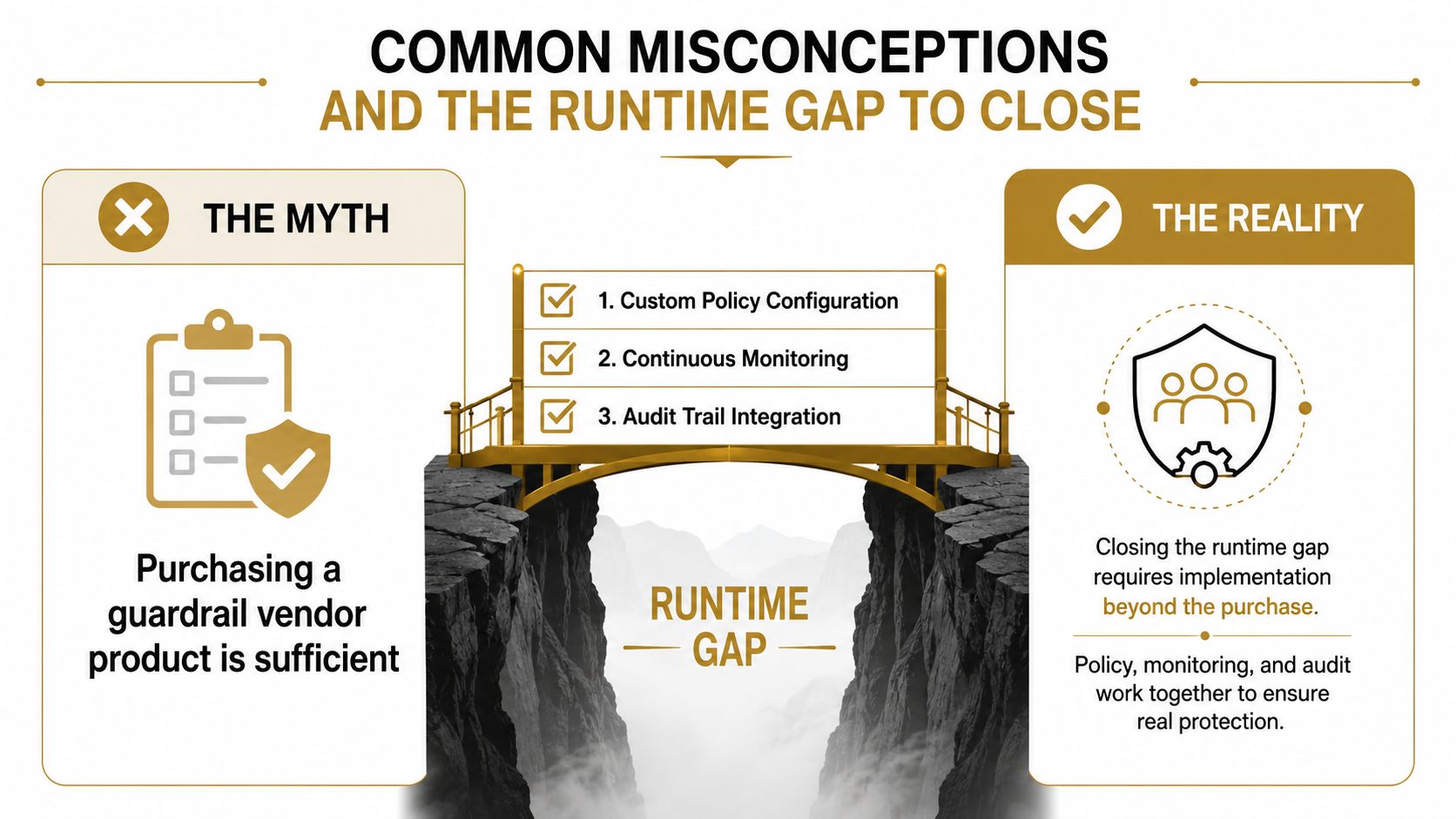
The biggest misconception is that buying a guardrail product closes the risk. It doesn't. A guardrail can be well designed and still fail if the system around it has no identity binding, no source pinning, and no monitoring once the draft leaves development.
The runtime gap in plain language
The runtime gap is the space between what the model was allowed to see and what the application is allowed to do. A filter might block toxic text, but it won't stop a prompt from pulling the wrong context, leaking a protected source, or triggering a workflow action it shouldn't have touched. That's why guardrails need to sit beside access control, logging, and lifecycle governance.
The policy debate in Australia is a good reminder of how the term “guardrails” evolved. The 2024 discussion around mandatory guardrails for high-risk AI became a reference point outside the EU and US, but later official materials still emphasized that the country had no general AI Act and that the guardrails remained voluntary rather than legally binding (policy background). The lesson for pharma is straightforward, governance often comes from existing legal and operational controls, not from one new label on a vendor page.
A second misconception is that production monitoring is optional once the prompt looks safe. It isn't. Runtime behavior changes as sources, users, and tools change, so a static evaluation can't guarantee ongoing control. The more your team depends on retrieval and multi-step workflows, the more important it becomes to watch the system in live use.
A simple decision checklist
Before you put LLM output into a regulated workflow, check four things, evidence traceability, reviewer handoff, version pinning, and incident response. If one of those is missing, the system may still produce content, but it won't produce content you can defend cleanly in MLR or audit.
You don't need to treat guardrails as a vendor checkbox. You need to treat them as the operating layer that keeps scientific content grounded, reviewable, and traceable while AI moves through production. If that's the standard your team is trying to meet, explore how VarsaAI connects source ingestion, sentence-level evidence tracking, and MLR-ready review into one workflow, then compare it against your current process before the next draft enters review.
Frequently asked questions
- How do LLM guardrails differ from prompt engineering?
Prompt engineering focuses on crafting inputs to coax a desired output from an LLM. Guardrails, however, define the system's operational boundaries, specifying what it can and cannot do, the evidence it can use, and how it should behave when encountering disallowed actions or content.
- Why is accuracy alone not a sufficient metric for guardrails in regulated publishing?
While high accuracy is desirable, precision and recall are equally important. High recall catches many issues, but poor precision leads to false positives, creating reviewer fatigue. In regulated fields, guardrails must efficiently block non-compliant content without excessive flagging of legitimate text.
- What is the 'runtime gap' in LLM guardrails?
The runtime gap refers to the disparity between what an LLM is permitted to access and its actual application capabilities. A guardrail might filter text, but it cannot prevent a prompt from accessing unauthorized contexts, leaking sensitive data, or initiating unintended actions within a workflow. Effective guardrails require integration with access control and logging.
- What are the key elements for an MLR-ready LLM workflow?
An MLR-ready workflow requires evidence traceability to sources, efficient reviewer handoff with all relevant context, version pinning of all inputs and outputs for consistency, and a robust incident response plan to address any issues that arise.
Add the trust layer to your LLM.
Every claim verified, every citation listed — inside your existing AI workflow.
Get pricing →