Reference Checker Explained for Pharma and Life Sciences
Learn what a reference checker does in pharma, how automated claim verification works, and how to evaluate tools for MLR-ready accuracy.
A reference checker in pharma and life sciences is a crucial tool for ensuring content accuracy and compliance. It verifies that claims are supported by cited sources, the sources are current, and they can withstand MLR scrutiny, moving beyond simple bibliography formatting to provide sentence-level evidence review.
Why does reference accuracy determine MLR success?
A medical affairs team can lose an afternoon, or longer, on a single unsupported sentence. The deck may be otherwise ready, the MOA narration may sound precise, and the citations may look clean in the footer. Then someone in MLR asks what one line proves, and the whole asset pauses.
That pause is not administrative noise. It shows the content has not yet moved from well written to reviewable and defensible. In regulated scientific work, a reference only matters if the team can show exactly what it supports and where that support appears in the source text. Biomedical citation-integrity research treats that as a sentence-level task, not a bibliography task, because the reviewer's question usually centers on one claim in one sentence. Reference integrity workflow in biomedical manuscripts
Why the problem shows up late
Bad references often look fine at first glance. A source can exist, the formatting can be correct, and the citation can still fail if the evidence does not match the claim. MLR review exposes that mismatch because it tests whether the sentence can stand up to scrutiny, not whether the reference list looks tidy.
Practical rule: if a sentence carries a scientific claim, it needs a source that supports that exact claim, not just a source that sounds related.
The pressure point is speed versus rigor. Faster content production creates more chances for mismatch, while manual checking slows review and gets noticed quickly. A good reference checker reduces that gap by shifting the question from “Do we have a citation?” to “Can we prove this sentence?” The wording changes only slightly, but the workflow changes a lot.
That difference also explains why reference quality affects trust. Reviewers do not need perfection in every draft, but they do need confidence that the team can trace claims back to evidence. Without that confidence, the content is treated as a risk, even when the underlying science is sound.
What does a reference checker really do in pharma?
A reference checker in life sciences can perform three distinct jobs, and separating them clarifies its value in medical affairs. It may format citations, confirm that sources exist, or verify whether each claim is supported by the evidence attached to it. The third function matters most during MLR review because it connects the wording of a sentence to the source that must defend it.
The formatting function checks author names, journal titles, DOIs, and reference-list entries for consistency. That improves presentation, but it cannot show whether a source supports the sentence beside it. Source validation goes one step further by confirming that a link resolves and a publication appears genuine. A genuine publication can still be unsuitable for the claim.

The pharma meaning is evidence alignment
The third job is the one MLR reviewers test: whether the cited source supports, partially supports, or contradicts the exact claim in the sentence. A practical guide also separates source type appropriateness and freshness from claim support, giving pharma teams three different questions to assess. How claim support, source type, and freshness fit into reference checking
A news editor offers a useful analogy. Reviewing a report means checking whether each sentence is supported by the quoted interview or named report, not merely counting its footnotes. In a regulated dossier, the consequence of a mismatch is an MLR hold or rework, not just an editorial correction.
For pharma teams, this distinction places the checker inside the review process rather than beside it as a citation formatter. A tool that only finds references can reduce formatting work. A tool that maps each scientific statement to its evidence source can help reviewers assess slides, scripts, and claims for reuse and auditability. That sentence-level map becomes particularly useful when one asset contains several scientific assertions.
VarsaAI's referencing guidance describes the sentence as the useful unit of reference checking, rather than treating the document as one undivided block. This matches how MLR reviewers examine medical content and helps connect reference validation with broader approval workflows.
How do automated reference checkers verify claims?
A medical writer submits a sentence claiming that a treatment improved a clinical outcome. The cited paper is real, but the paper may discuss a different population, endpoint, or study result. An automated reference checker helps expose that mismatch by testing the sentence against the evidence, rather than treating the citation as proof because its formatting is correct.
The workflow follows three linked steps. First, the system identifies the claim within the sentence. Next, it retrieves relevant evidence from the cited paper. Finally, it classifies the relationship between the claim and that evidence, such as support, partial support, or contradiction. This sentence-level process is particularly useful when one sentence contains several scientific assertions that require separate checks.
The distinction is important because two questions often become confused: Does the source exist and resolve correctly? and Does it support this exact wording? A valid article can still be a poor foundation for a particular argument. Keeping these checks separate gives MLR reviewers a clearer record of what the tool found and what still requires judgment.
The metadata layer still matters
Claim matching is only one part of a pharma reference check. The workflow also needs to locate the full text, confirm that the DOI or bibliographic record resolves, and compare the manuscript claim with the source before acceptance. Guidance from Wageningen University recommends screening for retractions and checking authoritative databases such as PubMed, Crossref, and Retraction Watch. A reference may be genuine and retrievable yet unsuitable if it has been retracted or no longer reflects the evidence being used. Reference validation, retractions, and authoritative databases
A reliable checker does not establish truth by itself. It identifies claims that need informed human review.
Automation handles a structured first pass, especially across long manuscripts, slide decks, and scripts. Human reviewers assess mixed claims, contextual qualifications, intended audiences, and whether the source is appropriate for the proposed communication. The tool therefore functions like clinical triage: it sorts findings by the attention they need, while the reviewer makes the final assessment.
For teams selecting or configuring a checker, the practical test is whether it displays the evidence behind its finding. Useful outputs show the claim, the cited source, the relevant passage, and the reason for a support or mismatch decision. They also distinguish a formatting problem, an unresolved record, and a weak evidence relationship. Guidance on citation checking and hallucination screening reinforces the same principle: references should be grounded in source content, not accepted because they appear plausible. That evidence trail lets the checker operate within MLR controls and supports later reuse in MOA content workflows.
Where does reference checking fit in MOA content pipelines?
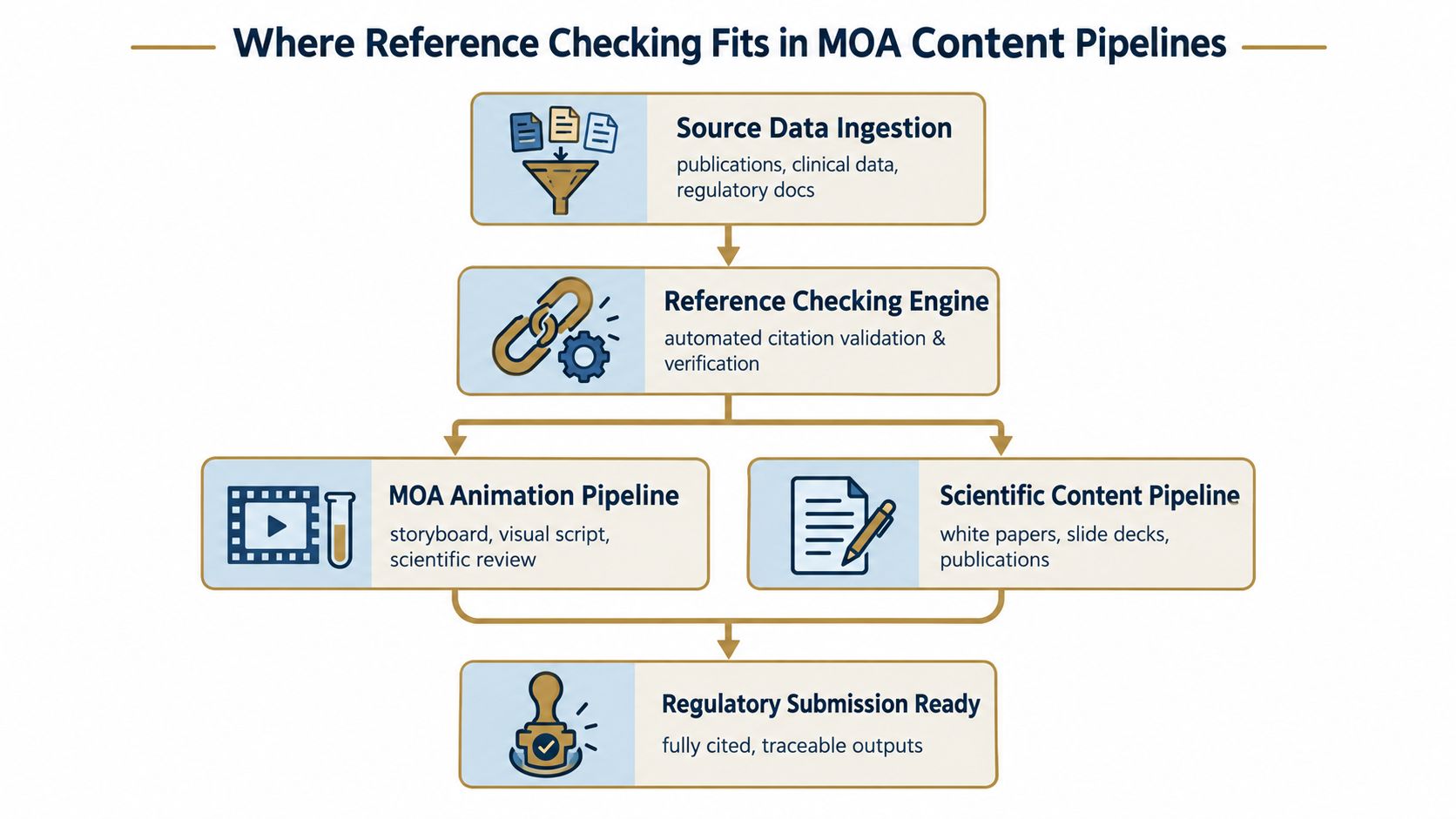
In an MOA pipeline, the reference checker belongs after source ingestion and before final approval, not after the creative work is already locked. That placement is important because the content is usually being assembled from publications, internal documents, and approved claims that need to stay synchronized as the asset develops. If validation happens too late, reviewers discover problems only after the narration, visuals, and slide structure are already invested in the wrong wording.
A useful way to think about it is a relay. Source materials enter first, then the checking layer confirms what can be used, then downstream content production builds on the approved material. In that setup, the checker acts like a gatekeeper for reuse, which is especially important when teams are drawing from a centralized library such as source document management guidance. The benefit is not just speed, it's consistency across versions, teams, and formats.
Why pipeline placement changes the review burden
If validation happens before scripting and animation, the team avoids rework later. That matters because scientific claims have a habit of expanding as they move from source text into storyboard language, speaker notes, and visual callouts. A sentence that looked harmless in a draft can become much harder to defend once it has been turned into a visual promise.
A tool like VarsaAI fits naturally. It supports source ingestion, sentence-level referencing, and a final validation pass inside the content workflow, so the checker is part of production rather than an afterthought. That structure also helps MLR teams because it preserves traceability as the asset moves from evidence to narrative to review-ready output.
The strongest workflow design uses the checker as a handoff point. Scientific teams can validate what enters the pipeline, content teams can build on approved material, and reviewers can inspect an audit trail instead of chasing sources manually. That's a very different model from uploading a finished deck at the end and hoping the references hold up. In regulated content, the earlier the traceability starts, the less friction the review team faces later.
How should one evaluate and compare reference checkers?
A pharma-grade reference checker should be judged on evidence quality, not on whether it can make a citation list look tidy. The easiest way to separate shallow tools from useful ones is to ask what happens after the metadata match. Does the tool stop at “this source exists,” or does it also test whether the source supports the claim, whether the source type is appropriate, and whether the reference is fresh enough for the context?
| Evaluation Criterion | Basic Citation Tool | Pharma Grade Checker |
|---|---|---|
| Citation formatting | Corrects style and layout | Corrects style and layout |
| Source existence | May confirm a record exists | Confirms the record exists and resolves |
| Claim support | Usually not checked | Checks whether the claim is supported by the source |
| Evidence strength | Not graded | Can separate support, partial support, and contradiction |
| Source type appropriateness | Rarely checked | Evaluated for fit to the claim |
| Freshness | Rarely checked | Considered as part of review |
| Retraction screening | Often absent | Included in the validation workflow |
| Audit trail | Limited | Built for traceability and review |
What to ask in a demo
The demo should expose whether the tool can handle a sentence with more than one claim. That's where weak products often collapse into a generic “citation found” response, while stronger systems show which evidence sentence supports which part of the statement. If the vendor can't show that mapping, the system is probably better at formatting than verification.
You should also ask how the checker handles source type. A review article, primary study, and internal document can all be relevant, but they don't carry the same evidentiary weight for every claim. The same goes for freshness. In regulated scientific content, recency can matter even when the citation is technically valid.
Decision rule: if a tool can't explain its support logic in plain language, it probably won't survive MLR scrutiny without extra manual work.
A final question is whether the checker supports auditability. Review teams need to know what was checked, what was flagged, and what changed. That's why evidence tracking is more valuable than a polished summary score. A tool that leaves a clear trail is easier to govern, easier to train on, and easier to defend when reviewers ask where the claim came from.
What are the adoption best practices and real-world use cases?
The safest adoption pattern is hybrid. Let automation do the first pass, then send flagged or ambiguous items to human review. That approach fits pharma work because it preserves speed without pretending that software can resolve every scientific nuance. It also makes reviewer effort more efficient, since the team can focus on the claims most likely to trigger questions.

A practical rollout pattern
Start with the most critical content types, not the entire library at once. MOA videos, launch decks, and externally shared scientific materials usually deserve priority because the review stakes are higher and the cost of rework is heavier. Once those materials have a stable workflow, teams can expand the checker to other formats with more confidence.
A few adoption habits make the system easier to govern:
- Automated first pass: use the checker to surface possible problems before a reviewer spends time on them.
- Human review phase: treat every flag as a prompt for judgment, not as a final verdict.
- Approval workflow: route validated references through the normal sign-off process so ownership stays clear.
- Audit trail logging: keep a record of checks, changes, and decisions for later review.
- Editorial system integration: connect the checker to the platform where content is already being built.
- Ongoing compliance checks: revisit important citations when source material changes or content gets reused.
Those habits are especially useful for field-facing and medical affairs content, where a reused claim can travel across slides, scripts, and presentations. A checked source library gives teams a steadier base for reuse, which reduces the chance that one outdated citation gets copied into multiple assets. It also makes onboarding easier because new team members can see what approved evidence looks like.
The win is consistency. Once teams know that every claim is going through the same evidence logic, MLR stops feeling like a rescue mission and starts functioning like a controlled process. That doesn't eliminate review, but it makes review more focused, more traceable, and less repetitive.
How does verifiable science build trust?
A reference checker in pharma is really a trust system. It helps reviewers trust the source, helps scientific teams trust the claim, and helps medical affairs trust that a reusable asset will still hold up when it reaches MLR. Once you see it that way, the tool stops looking like a citation formatter and starts looking like part of scientific governance.
The strongest workflows share the same shape. They begin with sentence-level evidence alignment, add metadata and retraction screening, place the checker inside the content pipeline, and leave a visible audit trail for review. That structure is what makes the process scalable without losing traceability. It's also why generic bibliography tools fall short in regulated content, even when they're perfectly fine for basic formatting.
For teams choosing a process, the main question isn't whether references look clean. It's whether every important claim can be traced to a source that supports it. That's the standard MLR expects, and it's the standard medical affairs teams should build around from the start. Sentence-level verification is slower to design than a simple citation cleanup step, but it saves far more time once content needs review, reuse, and sign-off.
If your current workflow still treats reference checking as a final formatting pass, it's time to reframe it as a claim-to-evidence gate. VarsaAI supports that kind of workflow for MOA videos and scientific content, with sentence-level referencing, validation, and MLR-ready outputs built into the production path. Visit VarsaAI to see how that approach can fit into your medical affairs process and reduce the friction between content creation and review.
Frequently asked questions
- What is the primary difference between a basic citation tool and a pharma-grade reference checker?
A basic citation tool focuses on formatting citations and confirming source existence. In contrast, a pharma-grade reference checker goes further by verifying if a source supports a claim, assessing evidence strength, checking source type appropriateness, and screening for retractions.
- Why is sentence-level referencing important in pharma?
Sentence-level referencing is crucial because MLR reviewers scrutinize individual claims within sentences, not just a document's bibliography. It ensures that each specific assertion is directly supported by its cited source, preventing potential mismatches and rework during review.
- What role does automation play in reference checking for scientific claims?
Automation identifies claims, retrieves relevant evidence from cited papers, and classifies the relationship (support, partial support, contradiction). This speeds up the initial pass, allowing human reviewers to focus on ambiguous cases and contextual nuances requiring expert judgment.
- How does proper placement of a reference checker in the MOA pipeline benefit content development?
Placing the checker early, after source ingestion but before final approval, ensures that content is built on validated claims. This prevents rework caused by incorrect wording locked in during later creative stages and maintains consistency across content versions and formats.
- What are key considerations when evaluating a reference checker for pharma use?
Key considerations include the tool's ability to verify claim support, distinguish evidence strength, assess source type appropriateness and freshness, screen for retractions, and provide a clear audit trail for traceability and review. It should show evidence for its findings.
Add the trust layer to your LLM.
Every claim verified, every citation listed — inside your existing AI workflow.
Get pricing →