Source Traceability in Pharma: A Practical Guide
Learn what source traceability means in life sciences, why regulators and MLR reviewers demand it, and how to build a verifiable evidence chain
Source traceability in pharma is a continuous, bidirectional evidence chain connecting a claim in an asset to its originating source, recording where, why, and how the source was used, and preserving this link through all subsequent changes. It enables verification of scientific claims, supports auditability, and streamlines MLR readiness.
An MSL submits a slide deck containing a claim about a reduction in hospitalizations. The reference appears in the footer as a conference poster, but the reviewer can't locate the poster in the approved repository. The writer has a PDF, the agency has an earlier version, and the clinical team remembers that the underlying result came from a larger clinical study report. The review stops while the team searches for the evidence.
That familiar scene creates several problems at once. The reviewer loses time, the MSL loses confidence in the deck, and the medical team begins debating what the claim was intended to mean instead of evaluating the science. If the team eventually finds a supporting document, it still has to confirm that the cited result matches the wording, population, endpoint, analysis set, and context used in the slide.
The hidden cost of a missing evidence chain
A reference list can make content look supported while leaving the most important questions unanswered:
- Which source version was used? A poster may have preliminary findings, while a later publication or report may contain a revised analysis.
- Where is the supporting passage? A document title alone doesn't show whether the claim comes from the abstract, a table, a figure, or an interpretation.
- Who made the connection? Reviewers need to know whether the link was created by a medical writer, an MSL, an agency, or an automated system.
- What changed afterward? A sentence may have been softened, expanded, or rewritten while its citation stayed untouched.
Practical rule: If a reviewer has to reconstruct the evidence chain manually, the content wasn't ready for efficient review.
Source traceability would have connected the claim to a persistent source record before submission. The record would identify the document, preserve the relevant location, capture the source version and retrieval information, and retain the relationship between the claim and the evidence through later edits. That doesn't replace scientific judgment. It makes the judgment inspectable.
What strong traceability protects
The immediate benefit is faster issue resolution, but the deeper value is broader. A traceable workflow supports scientific accuracy, because writers can compare a sentence with the exact evidence rather than rely on memory. It supports auditability, because the organization can reproduce how a claim entered an asset. It supports regulatory alignment, because the team can demonstrate control over source use. It also improves MLR readiness, because reviewers receive evidence that's already organized at the level where questions arise.
Source traceability became a formal quality concept in the late twentieth century. A French traceability history document notes that ISO 8402 defined traceability for the first time in 1987, followed by French batch-number labeling requirements for food products in 1991. In Europe, Regulation (EC) No 178/2002 established the need for traceability across food and feed businesses, and Commission Implementing Regulation (EU) No 931/2011 reinforced requirements for food of animal origin. The broader lesson applies to scientific content: traceability moved from a quality idea toward an expectation that organizations can prove provenance.
What does source traceability mean?
Source traceability is a continuous, bidirectional evidence chain. It connects a claim in a final asset to its originating source and also records where, why, and how that source was used. The chain should remain understandable when the claim changes, the source is updated, the asset is reused, or a different reviewer examines the work.
A parcel-tracking analogy makes the distinction clear. When you track a delivery, you don't see only the destination. You see the pickup record, transfer points, timestamps, handling events, and proof of delivery. In a scientific content workflow, source ingestion is the pickup, metadata records the handoffs, sentence-level linking identifies the destination of the evidence, and the audit trail shows what happened along the way.

The three properties of a traceable claim
A traceable claim needs more than a citation number. At minimum, it should carry three connected properties:
- A stable source identifier. This might be a DOI, PMID, controlled internal document ID, approved label record, or another identifier that remains associated with the source in the organization's repository.
- A precise source location. The record should point to the page, table, figure, section, paragraph, or passage where the evidence appears. “Supported by the paper” is too broad for a reviewer who needs to verify the wording.
- Linking metadata. The workflow should retain who created or approved the link, when the link was created or reviewed, and which source version informed the claim.
The chain must work in both directions. Starting with a slide sentence, a reviewer should reach the relevant evidence. Starting with a source passage, a medical affairs lead should be able to see every approved or draft asset that uses it. That reverse path matters when a source is corrected, superseded, or withdrawn.
Traceability is not the same as citation hygiene
Citation hygiene means using references consistently, formatting them correctly, and avoiding obvious omissions. It's valuable, but it answers a narrower question: Does the asset cite something?
Version control records changes to a document or asset. It can show that a slide changed, but it doesn't necessarily show whether the supporting evidence changed with it. Source traceability combines these disciplines with provenance. It answers a harder question: Can the organization demonstrate the complete path from source ingestion to final claim, including the decisions made during transformation?
In pharma-oriented AI workflows, a four-link traceability model for regulated AI describes the chain as source to knowledge base, knowledge base to retrieval, retrieval to output generation, and output to audit trail. If one link is missing, the output can't be independently verified in the way regulated GxP work may require.
Why do regulators and reviewers care about source traceability?
Regulators and internal reviewers aren't asking only whether a scientific claim sounds plausible. They're asking whether the organization can show how it knows the claim is accurate, current, appropriately contextualized, and suitable for the intended audience.
For U.S. food systems, the regulatory arc illustrates how traceability becomes operational. Congress directed FDA to create food traceability regulations through the Public Health Security and Bioterrorism Preparedness and Response Act of 2002, FDA published initial recordkeeping rules in December 2004, and Section 204 of the Food Safety Modernization Act, signed on 4 January 2011, required stronger tracking and tracing for foods often associated with outbreaks. FDA published a proposed food traceability rule on 23 March 2020, as explained in this congressional and regulatory timeline. Scientific content teams face a different subject matter, but the governance principle is similar: records must support reconstruction when someone challenges provenance.
What this means for medical affairs
The FDA's SIUU final guidance is particularly useful for operational thinking. It says that firm-generated scientific presentations should remain limited to source publications, include those publications with the presentation, and stay tied to the recommendations in the guidance. For a medical affairs team, that translates into practical controls:
- Map claims to evidence. A reviewer should identify the exact publication or internal source supporting each scientific statement.
- Preserve source versions. The team should know whether it used an accepted manuscript, a final publication, a poster, a report, or a later revision.
- Retain linking decisions. The organization should preserve who reviewed the evidence and whether the source supports the claim directly or only provides background.
- Reproduce the chain. A reviewer or auditor should be able to follow the path without depending on the memory of one writer.
The same discipline helps teams working under internal SOPs, even when a regulation doesn't prescribe a particular database field. Medical, legal, regulatory, payer, and procurement stakeholders often rely on the same evidence record. A weak trail creates friction for all of them.
Regulatory drivers and operational consequences
| Driver | Operational Requirement |
|---|---|
| FDA SIUU guidance | Keep scientific presentations tied to source publications, include those publications, and document the claim-to-source relationship. |
| FDA promotional review expectations | Support truthful, non-misleading scientific communication with evidence that can be checked in context. |
| U.S. traceability modernization | Maintain records that support reconstruction, targeted action, and accurate information sharing, a governance model relevant to controlled content operations. |
| EU traceability expectations | Preserve provenance, identifiers, and chain-of-custody information where regulated records require reconstruction. |
| Internal MLR procedures | Make source location, version, reviewer decision, and approval status visible before submission. |
Medical affairs organizations that need to operationalize these controls can evaluate workflows designed for life sciences content operations. The technology matters less than the control objective: every final claim should have an evidence path that remains intelligible after review.
A bibliography doesn't prove that the claim is accurate. It proves only that someone placed references near the claim. Reviewers care about the stronger standard, whether the organization can defend the relationship between wording and evidence under inspection, reuse, or challenge.
How does traceability support accuracy, auditability, and MLR readiness?
Traceability creates four separate operational outcomes. Teams often collapse them into “compliance,” but that makes it harder to design the right controls and measure whether they work.
Scientific accuracy
Sentence-level linking reduces claim drift. A medical writer may begin with a precise statement about a defined endpoint, then revise the sentence for a slide, shorten it for a field handout, and adapt it for a manuscript. Each rewrite can broaden the population, change the strength of the conclusion, or turn an association into a causal statement.
Suppose an MLR reviewer pauses on a mechanism claim. With document-level citation, the reviewer opens a long publication and searches for support. With sentence-level traceability, the reviewer sees the exact passage selected by the author, checks whether it supports the sentence, and can request a targeted revision. The workflow brings the scientific question into view before the claim travels farther.
Auditability
An auditable chain preserves more than the final reference. It records the source identifier, source version, relevant location, linking user, review event, and later edits. A reviewer examining a historical asset should be able to determine what the team knew and which evidence it used at the time of approval.
A practical guide to supply-chain traceability recommends documenting item description, manufacturer identity, and intermediaries, and retaining traceability records for at least 10 years after final payment. The content context differs, but the design lesson is direct: durable provenance depends on standardized identifiers, complete chain capture, and retention that outlasts the immediate project.
MLR readiness
Pre-linked evidence changes the reviewer's task. Instead of reverse-engineering how a writer selected a source, the reviewer evaluates whether the source supports the wording and whether the communication is appropriate. That makes review more substantive and less administrative.
A deck can pass through many revisions, including changes to a headline, footnote, visual, and speaker notes. If the system retains the claim-to-source relationship as the text changes, reviewers can focus on the implications of the revision instead of restarting the evidence search.
Controlled reuse
A field team may reuse an approved slide months after the original review. Without traceability, the team may copy the visible reference but lose the supporting passage, approval context, or source status. With a governed evidence link, the reused claim remains connected to its provenance and can be checked against current policy before publication.
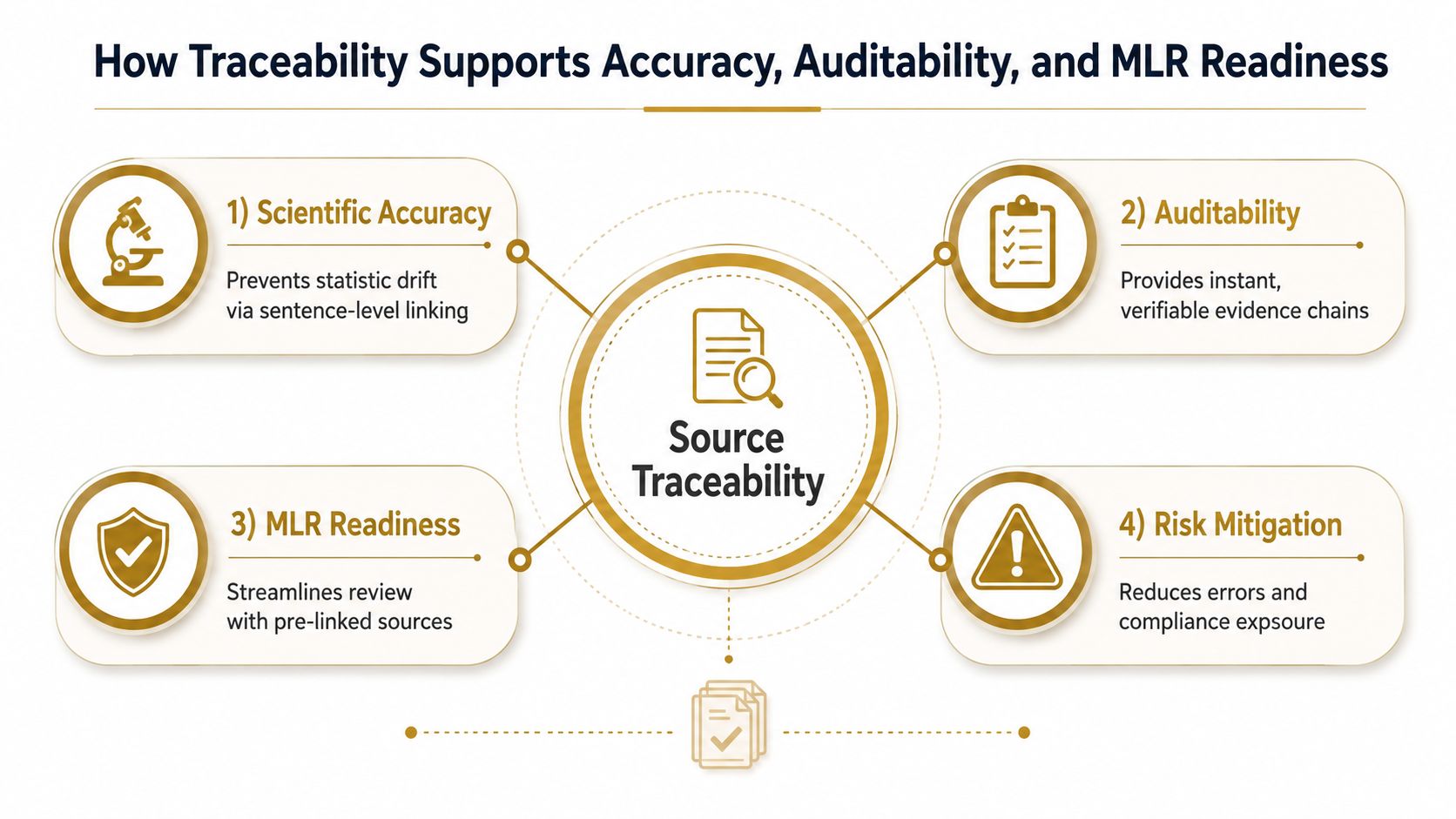
These outcomes reinforce one another without being interchangeable. Accuracy protects the science, auditability protects the record, MLR readiness protects the review process, and controlled reuse protects consistency across teams and formats.
What are the technical approaches to building a traceable workflow?
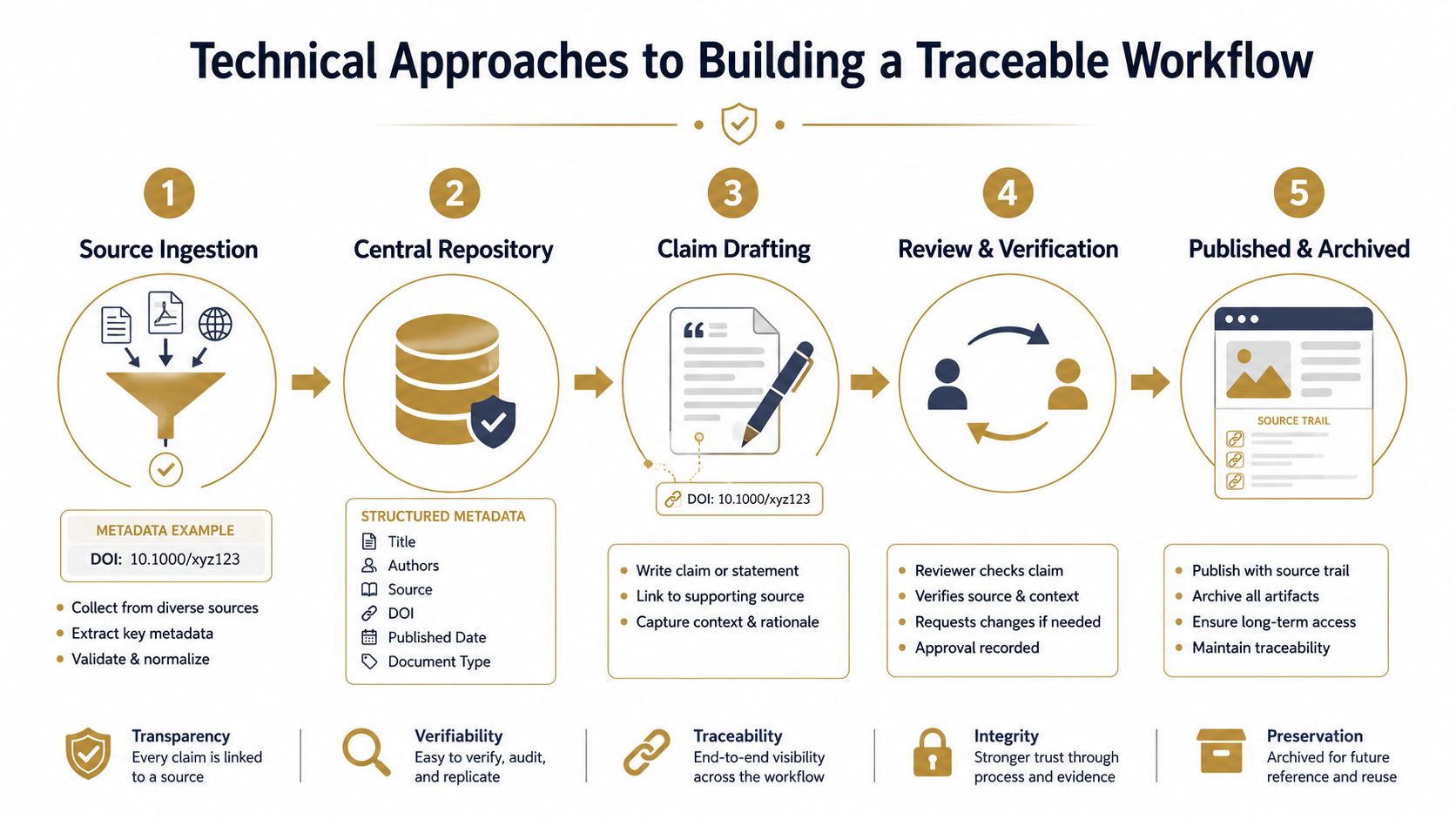
A traceable system doesn't begin with AI generation. It begins with controlled source handling. The workflow below follows the evidence as it moves from an approved document into a final scientific asset.
Start with source ingestion
Every approved reference should enter a controlled environment with useful metadata. For a publication, that may include the DOI, PMID, title, authors, journal, publication status, and therapeutic area. For sponsor-supplied evidence, the record may include the internal document identifier, owner, confidentiality classification, approval status, and permitted use.
Ingestion should preserve the original file and record how it entered the repository. A copied paragraph in a word-processing file is not equivalent to an ingested source because the paragraph can lose context, pagination, tables, and provenance.
Assign an immutable identity
A source needs an identifier that doesn't change when a team renames the file or moves it between folders. The identifier should point to a controlled record, while the record retains the source version and relevant metadata.
This prevents silent link failure. If a 2022 publication is replaced by a corrected version, the system should preserve the earlier record and create a visible relationship between the versions. Writers and reviewers can then see whether the original claim remains supported.
Build a granular knowledge base
A document repository stores sources. A knowledge base makes evidence findable at the level of claims, snippets, concepts, and entities. It should support retrieval of a relevant passage rather than returning an entire publication with no indication of what matters.
For example, a medical writer drafting a CSO deck searches for a primary efficacy finding. The system surfaces a publication tagged primary efficacy, displays the selected passage, and shows the source record attached to that passage. The writer still evaluates the evidence, but the workflow reduces the chance of attaching a familiar citation to the wrong sentence.
Link evidence during drafting
The authoring environment should let the writer connect a sentence to the source ID while drafting, not after the deck is complete. Late citation creates a predictable failure mode: the writer remembers the general paper but can't reconstruct the exact evidence used for each sentence.
Tools that support structured referencing workflows can place the source relationship close to the claim. That relationship should remain intact when the sentence moves between a slide, presentation notes, PDF, manuscript, or other approved format.
Preserve the audit trail
The final component records every meaningful event: source ingestion, claim creation, link changes, reviewer comments, approvals, and publication. In the example above, the system might capture that Medical Affairs last touched the claim on March 14, along with the source version and review status. The exact date is useful only because it sits inside a broader record that explains what changed.
A technically advanced system can still fail if the source records are incomplete or the team doesn't use the linking function. Governance and adoption therefore belong inside the workflow, not beside it.
What governance practices keep traceability durable?
A team can create a neat bibliography manually and still lack durable traceability. Lightweight habits work for a stable document with one author, but they break under draft churn, handoffs, and AI-assisted rewriting.
The difference is whether the organization treats a citation as decoration or as a controlled relationship between evidence and content.
| Practice Area | Lightweight Habit (Failure Mode) | Durable Governance Practice |
|---|---|---|
| Source ownership | Anyone adds a paper to a shared folder, creating duplicates and uncertain status. | Assign owners who curate approved sources and maintain their metadata. |
| Claim linking | Writers paste references into footers after drafting, so revised sentences may retain the wrong citation. | Require sentence-level linking during authoring. |
| Version handling | Teams overwrite files or rename PDFs, obscuring which source informed approval. | Pin source versions and preserve relationships between superseded and current records. |
| AI-assisted drafting | A model rewrites text while citations remain attached to the earlier wording. | Require evidence retrieval, claim verification, and human approval for generated output. |
| Source freshness | Teams discover outdated or withdrawn evidence during review. | Run freshness checks and route flagged sources to a designated owner. |
| Cross-team reuse | A field or agency team copies a slide without its evidence context. | Reuse governed claims with visible provenance and approval status. |
| Quality assurance | Audits begin only after a problem appears. | Conduct periodic cross-functional audits of claims, sources, and decisions. |
Where manual processes fail
Copy-pasting references can't reliably preserve passage-level support. Manual citation updates are especially fragile when an agency changes the order of slides, merges claims, or adapts one approved asset into several formats. AI adds another layer of risk because it can generate fluent wording faster than a person can recheck every citation.
The answer isn't to ban tools. It's to make source relationships machine-readable and reviewable. A generated sentence should carry its evidence path, and a human reviewer should decide whether the evidence supports the final wording and intended use.
What reviewers actually want
Reviewers rarely need a grand technical explanation. They need a clear answer to a practical question: Can I verify this claim quickly, and can the organization defend the verification later?
That requires more than a bibliography. It requires an unbroken chain from approved source to final content, with the version, location, linking decision, reviewer, and subsequent changes available when needed.
What are the implementation checklist and metrics for success?
Implementation works best as a controlled rollout rather than a technology launch. Start by defining what the organization must be able to prove, then build the workflow around that requirement.
Phase one is preparation
Before selecting a platform, establish the evidence environment:
- Inventory sources: Identify publications, labels, clinical documents, posters, internal scientific materials, and other source classes used in content.
- Define a taxonomy: Create consistent tags for therapeutic area, evidence type, population, endpoint, approval status, and permitted use.
- Assign source ownership: Give a reference librarian, medical information lead, or designated scientific owner responsibility for curation.
- Select the source of truth: Decide which repository holds the controlled source record and how teams will handle duplicates, corrections, and superseded versions.
- Document escalation: Specify who resolves conflicts when a claim appears supported by multiple sources or when evidence is incomplete.
Phase two is a focused pilot
Choose one asset class, such as scientific presentations or MSL decks. Include at least one medical reviewer and one additional stakeholder who understands the downstream use, then establish a baseline for the current review process before changing it.
The pilot should test the full chain, not just citation display. Ingest sources, create claims, link passages, revise wording, complete review, approve the asset, and attempt reuse. Ask a reviewer who wasn't involved in drafting to reproduce the evidence path from the final sentence.
Phase three is controlled expansion
Once the pilot exposes gaps, integrate the workflow with MLR procedures, agency handoffs, vendor records, and AI-generation guardrails. Define which generated content requires source verification, who owns final scientific judgment, and how the organization archives the evidence record.
Teams can use industry outcome planning to connect content governance with broader operational objectives, but the measures should remain practical and tied to review behavior.
Metrics that show whether the system works
Track leading indicators while the workflow is still being adopted:
- Claim-to-source coverage: The share of claims with a valid source identifier and precise source location.
- Traceability score per draft: The proportion of claims that remain linked after each revision.
- Time to citation during MLR review: How long reviewers spend locating evidence for challenged claims.
- Unsupported claims caught before submission: The number of gaps identified internally before the asset reaches formal review.
- Source freshness: Whether active claims rely on current, approved source versions.
- Revision-cycle reduction: Whether fewer review rounds are needed to resolve evidence and provenance issues.
Lagging indicators show whether governance has held over time. Review audit findings, recurring source failures, regulator response times, and repeated rework patterns can reveal weaknesses that a dashboard may hide. Metrics should drive quarterly governance decisions, such as improving taxonomy, retraining writers, retiring unreliable sources, or adjusting review gates.
The stalled deck in the opening scenario would have taken a different path if its claim had carried an identifiable source, an exact evidence location, and a retained linking record. The team could have resolved the question before submission instead of searching for the underlying document during a live review queue. That's the practical promise of source traceability, not a longer reference list, but a workflow that keeps scientific evidence connected to the content people approve, reuse, and defend.
VarsaAI provides pharmaceutical teams with source ingestion, centralized content management, sentence-level referencing, scientific verification, and controls intended to support MLR-ready presentations and related scientific assets. Visit VarsaAI to evaluate how a governed evidence workflow could fit your medical affairs process.
Frequently asked questions
- What is claim drift and how does traceability help prevent it?
Claim drift occurs when a scientific statement subtly changes meaning through multiple revisions for different formats. Traceability, particularly sentence-level linking, ensures that each iteration of a claim remains connected to its original, precise evidence, allowing reviewers to identify and correct any unintended changes in meaning.
- How does source traceability differ from citation hygiene?
Citation hygiene focuses on consistent referencing and correct formatting, answering if something is cited. Source traceability, however, proves the complete path from source ingestion to the final claim, including decisions made during transformation, demonstrating how the organization knows the claim is accurate.
- What are the three essential properties of a traceable claim?
A traceable claim must have a stable source identifier (e.g., DOI, internal ID), a precise source location (e.g., page, paragraph), and linking metadata (who created/approved the link, when, and which source version was used).
- Why is preserving the audit trail important for traceability?
Preserving the audit trail records every meaningful event, such as source ingestion, claim creation, link changes, and approvals. This ensures that a reviewer examining a historical asset can reconstruct what was known and which evidence was used at the time of approval, supporting auditability and regulatory compliance.
- What role does source ingestion play in a traceable workflow?
Source ingestion is the initial step where every approved reference enters a controlled environment with metadata, preserving the original file and recording its entry into the repository. This controlled start is crucial for assigning immutable identities and building a granular knowledge base for evidence.
Add the trust layer to your LLM.
Every claim verified, every citation listed — inside your existing AI workflow.
Get pricing →