AI Compliance Software Explained for Life Sciences Teams
Learn what AI compliance software does for life sciences, from MLR readiness to audit trails, and how to evaluate it for pharma workflows.
AI compliance software in life sciences enables rapid content generation while maintaining auditability and regulatory compliance, integrating controls like sentence-level traceability, audit trails, and access management. This ensures that AI-generated content can withstand stringent medical, legal, and regulatory reviews, accelerating workflows without compromising data integrity or regulatory adherence.
Why does AI compliance matter now for life sciences teams?
Medical affairs teams usually don't feel compliance pressure in a single dramatic moment. It shows up as five small delays, a missing source citation, a reviewer who can't confirm the origin of a sentence, a legal question about who changed the deck, and a second round of edits because the version history is messy. The work itself is good, but the process around it slows down because AI content behaves like a fast draft, while MLR needs a controlled record.
That's why AI compliance software has moved from a nice-to-have to core infrastructure. The market for AI compliance software was valued at USD 2.85 billion in 2024 and increased to USD 3.52 billion in 2025, with one forecast projecting USD 19.9 billion by 2033 at a 24.2% CAGR MarkSparksolutions. That growth reflects a simple reality, organizations are buying tools to manage governance, monitoring, and regulatory obligations as AI use becomes more formalized.
For life sciences teams, the key shift is mental. Compliance software is no longer just about enterprise risk. It's becoming part of the workflow that keeps AI-generated content review-ready, auditable, and easier to defend during MLR. The people approving the asset don't just need to see the final answer, they need to see how the answer was built.
A useful way to think about it is this, AI can help generate the first draft, but compliance software has to preserve the evidence trail behind that draft. That includes what source material was used, what changed, who approved it, and what rule the system applied. When those pieces are visible, reviewers spend less time reconstructing the file and more time evaluating the science.
What does AI compliance software do?
Think of AI compliance software as a mix of a flight recorder and a quality system. A flight recorder captures what happened, while a quality system helps make sure the work followed the right process. In regulated content, you need both. MLR reviewers need to know not only what the AI produced, but how that output was formed, what evidence supported it, and whether the right controls were in place.
A practical definition for life sciences
In life sciences, the software's job is not to “make AI safe” in the abstract. It is to govern AI generation so that outputs can survive medical, legal, and regulatory review. That means it helps enforce policies, capture traceability, support human oversight, and keep the content ready for approval. The point isn't automation for its own sake, it's controlled automation.
A generic AI tool might draft a paragraph quickly. AI compliance software goes further, it can show where the claim came from, preserve the approval path, and restrict how the output enters a review workflow. That matters because MLR isn't judging creativity, it's judging whether the content is supportable, current, and properly documented. The software has to behave like a controlled workspace, not a freeform writing assistant.
Practical rule: if a reviewer can't reconstruct the content from the system record, the content is not truly ready for MLR.
Why is AI compliance software different from generic content tools?
Traditional eQMS and content management systems are built to manage documents, approvals, and records. They're important, but they weren't designed to govern AI generation at the sentence level. AI compliance software fills that gap by connecting the generation step to the control step, so the output isn't just stored, it's evidence-backed.
That distinction matters in MLR. A normal repository can tell you which version was approved. A compliance-aware AI workflow can tell you which source was used for a specific sentence, which reviewer accepted it, and how the output maps to your current policy. That gives medical affairs a cleaner path from draft to approval, with fewer blind spots for legal and regulatory review.
What regulatory foundations should life sciences teams know?
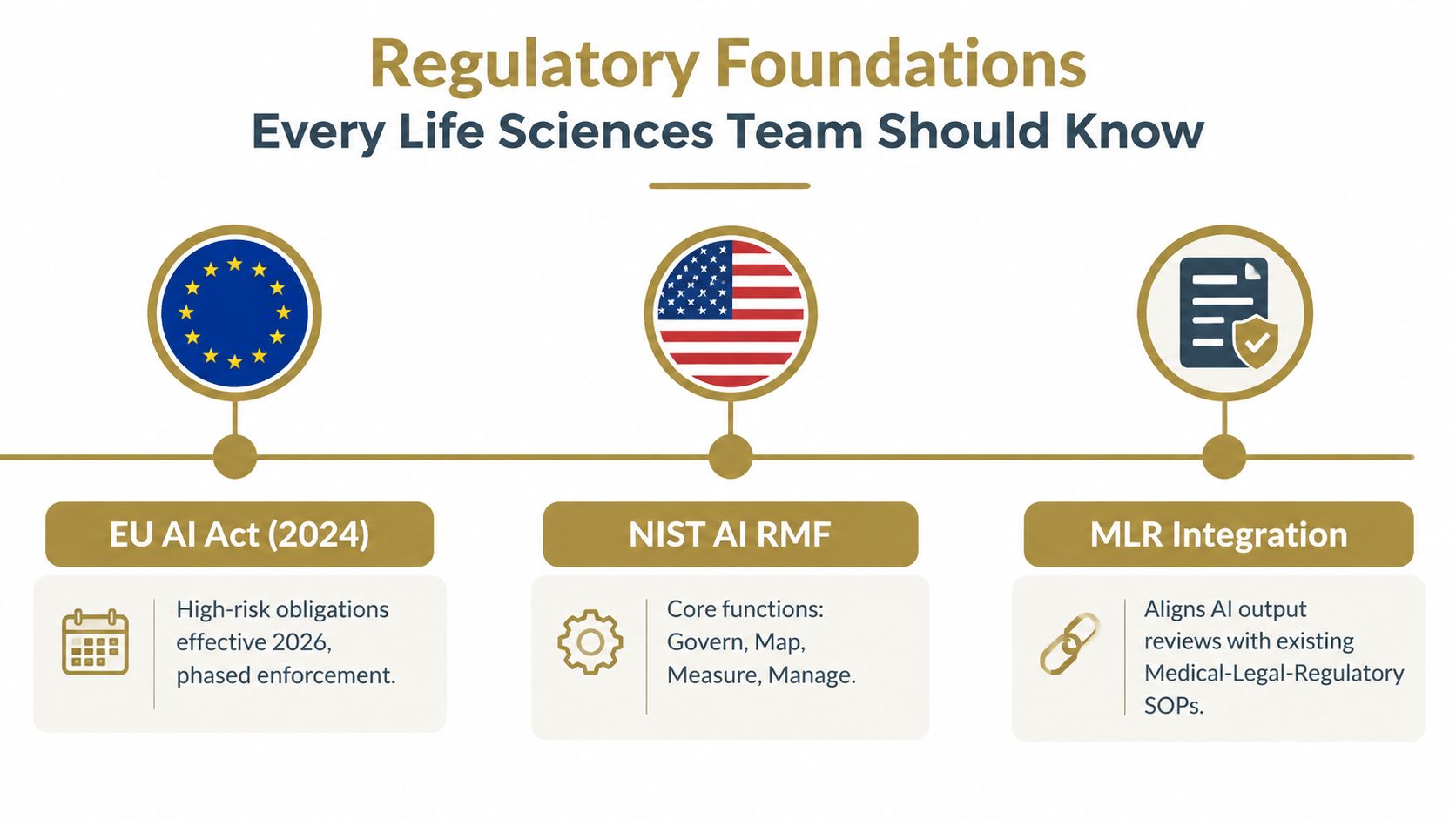
The regulations shaping AI compliance software are not theoretical, they're already influencing how teams design workflows. The EU AI Act is the clearest example. It entered into force on 1 August 2024, became generally applicable on 2 August 2026, and places strict obligations on high-risk AI systems, including risk mitigation, high-quality datasets, user information, human oversight, and conformity assessment before market placement European Commission. For global companies, that means software has to help document controls, explain outputs, and preserve traceability across regulated work.
The financial exposure is also real. The Act cites fines of up to EUR 35 million or 7% of global annual turnover for prohibited practices, and up to EUR 15 million or 3% for other infringements European Commission. In practice, that doesn't just change legal risk, it changes procurement questions. Buyers now ask whether a platform can support evidence capture, documentation generation, and post-market monitoring, because those are the kinds of controls a regulated organization may need to demonstrate.
How do NIST and MLR fit into the same picture?
The NIST AI RMF adds a useful operating model. It breaks AI risk work into four functions, Govern, Map, Measure, Manage AI Governance Stack. That structure maps neatly to software requirements. Teams need policy workflows, AI system registration, risk classification, continuous risk assessment, and remediation tracking. If the platform only generates content, it's missing most of the governance job.
MLR creates another layer of expectation. Reviewers are already trained to ask whether a claim is supported, whether the evidence is current, and whether the file follows SOP. AI now adds a new question, can the system show how the draft was produced and controlled? That's why documentation, version control, and post-market traceability matter so much. The software has to preserve the record behind the content, not just the content itself.

What are auditors and reviewers really asking for?
When an auditor or MLR reviewer opens the file, the questions are simple. What did the AI use? Who checked it? What rule was applied? Can we reproduce the result if we need to? The more directly the software answers those questions, the less time reviewers spend chasing evidence across shared drives and email threads.
That's why compliance requirements are no longer separate from product design. They're part of the platform brief. A system that can't support traceable decisions, controlled edits, and searchable evidence won't fit the reality of regulated workflows, even if it is strong at drafting.
What core features make AI outputs audit-ready?
The most useful way to judge AI compliance software is to ask a simple question, can it turn a generated draft into a record that MLR can trust? That depends on a set of features working together, not one flashy capability. A good platform behaves less like a chatbot and more like a controlled evidence system.
Traceability starts at the sentence level
Sentence-level referencing is the clearest sign that a platform is built for regulated work. If a claim appears in a deck or video script, reviewers should be able to see where that statement came from. The need for traceable evidence shows up even more sharply in pharma-grade workflows, where a reviewer may want to verify one line without rereading the entire source pack. For a deeper look at this control, see source traceability in regulated AI workflows.
That same logic applies to provenance and data lineage. The software should preserve which documents, publications, or internal materials fed the output, and which version of those materials was used. When content changes, version control helps MLR understand whether the update was editorial, scientific, or policy-driven.
Every claim needs a path back to evidence, or the review turns into guesswork.
Audit trails and validation do the heavy lifting
A tamper-evident audit trail is what makes the record believable. Regulators and internal reviewers need reconstructable evidence of what the system did, who authorized it, and what policy outcome occurred. A compliant log typically captures structured metadata such as event type, timestamp, user ID, action, outcome, and rule reference while avoiding unnecessary storage of the underlying content Sphere. That structure reduces privacy exposure and makes filtered exports easier when a supervisory review happens.
Validation is the other half of the story. A platform should not assume that any generated output is acceptable just because it was produced by a model. It needs a reviewable validation process, ideally one that checks the output against approved evidence and company policy before the content reaches MLR. In pharma settings, this becomes especially important because scientific accuracy and compliance readiness are closely linked.
Access control and retention are not background settings
Access control determines who can create, edit, approve, or export content. That matters because MLR needs separation of responsibilities, not a shared free-for-all. Retention-aware storage matters too, because systems are designed to retain the longest required period across applicable regimes, with examples including six months for EU AI Act logging on high-risk systems, five years for DORA ICT incident records, and six years for FINRA books-and-records requirements Sphere. Even if your use case isn't financial services, the lesson is the same, storage, indexing, and export workflows have to respect retention from the start.
How can life sciences teams evaluate and choose the right AI compliance platform?
Choosing a platform is easier when you stop asking, “Does it use AI?” and start asking, “Can it support MLR the way we work?” The best vendor for regulated life sciences usually isn't the one with the broadest marketing story. It's the one that can prove the content path, respect your SOPs, and fit into existing approval gates without creating extra admin.
| Evaluation Criteria | What Good Looks Like | Why It Matters for MLR |
|---|---|---|
| Evidence traceability | Every claim maps back to a source, with clear version history | Reviewers need to verify support without rebuilding the file |
| Workflow fit | Approval steps mirror medical, legal, and regulatory review paths | If the system forces a new process, adoption slows |
| Security posture | Strong controls, clear access management, and enterprise-grade compliance posture | MLR content often contains sensitive scientific and business material |
| Documentation support | Exports, metadata, and control records are easy to generate | Audits and internal checks need clean records |
| IP ownership | Your organization retains ownership of generated assets and outputs | Teams need clarity on reuse, sharing, and downstream use |
| Centralized library | Approved materials are stored in one controlled place | Reuse is safer when people pull from a governed source |
| Implementation support | Onboarding, training, and workflow setup are part of the package | Most failures happen during rollout, not procurement |
A platform with strong governance depth should also show how it handles AI policy, human oversight, and continuous review. If the vendor can't explain how content remains reviewable after generation, that's a warning sign. Ask whether it can support sentence-level evidence, controlled reuse, and role-based permissions, because those are the controls MLR feels every day.
When you compare options, separate generic AI capability from regulated workflow capability. The first helps with drafting. The second helps with approval. In life sciences, the second usually matters more.
What should you ask in a vendor conversation?
- Can reviewers see source links at the claim level? This tells you whether the platform is built for evidence-backed content or just document storage.
- Does the workflow match our MLR SOPs? If not, you'll spend time customizing around the tool instead of using it.
- How are approved assets stored and reused? A controlled library reduces rework and prevents duplicate, unreviewed variants.
- What happens to the audit record when content changes? You want version continuity, not a broken chain of approvals.
- Who owns the output files and derivative assets? That answer matters for downstream use in presentations, training, and omnichannel content.
One platform that fits this conversation is VarsaAI, which creates MOA videos and related scientific content with sentence-level referencing, a centralized Hub, and MLR-ready outputs. It sits in the category of tools that combine generation with governance, which is the right frame for regulated teams evaluating options.
How can AI compliance software be implemented without disrupting MLR?
Rollout works best when it feels like a controlled process upgrade, not a new tool dropped on reviewers. Start with stakeholder alignment. Medical, legal, regulatory, IT, and content owners need to agree on what the software will govern, which asset types it will touch first, and where human approval still sits. If those decisions aren't made early, people will treat the platform as optional, and optional systems rarely become trusted systems.
Map the current process before changing it
The cleanest implementations begin with existing SOPs. Map the current MLR path, then align the new workflow to it instead of asking reviewers to learn a different logic. That includes source intake, drafting, evidence checks, reviewer comments, final approval, and record retention. For a practical view of the trust layer concept behind that approach, see VarsaAI's AI trust layer overview.
After that, set up data ingestion and the approved content library. The goal is to load the right source material, not every file the company has ever produced. If the library is cluttered, reviewers lose confidence fast. A smaller, governed source set is usually easier to trust than a sprawling archive.
Train for adoption, not just access
Training should be role-specific. Authors need to know how to request or generate content correctly. Reviewers need to know where the evidence sits and how to check the audit record. IT and admins need to understand permissions, retention, and export logic. When each group sees its own responsibility, the rollout feels more practical and less abstract.
Implementation rule: start with one team, one content type, and one reviewer group, then expand only after the workflow feels predictable.
Phased rollout gives you room to catch friction before it spreads. It also keeps human oversight in place, which matters more than any feature list. The measure of success is whether MLR can review content faster because the evidence is cleaner, not because anyone skipped a step.
Can compliant AI be seen in action with real examples?
A medical affairs team preparing an MOA video often starts with scattered source materials, a target message, and a deadline that doesn't leave room for a long agency cycle. In a traditional workflow, that kind of content can take weeks to move through drafting, scientific review, and MLR approval. In a governed AI workflow, the team can ingest source documents, generate a draft, and preserve a sentence-level evidence trail before the file ever reaches reviewers.
That's where the compliance layer changes the pace of work. A platform like VarsaAI is designed to produce MOA videos and related presentations from source materials, while keeping claims linked to evidence, using a centralized Hub for approved content reuse, and supporting review with VeriCore validation. The important part is not just speed, it's that the output is structured for MLR from the start, so reviewers can focus on scientific judgment instead of reconstructing provenance.
A practical benefit shows up when teams need consistency across formats. The same governed source set can feed a presentation, a PDF, and a video asset without everyone rebuilding the story from scratch. That keeps scientific messaging aligned and reduces the kind of rework that usually happens when assets are created in separate silos.
The broader lesson is simple. Compliance doesn't have to slow content down when it's built into the creation path. When governance, evidence, and review readiness sit inside the workflow, MLR gets cleaner files, authors get fewer loops, and medical affairs can scale content without loosening control.
If your team is trying to produce faster scientific content without giving up MLR discipline, VarsaAI is built for that exact workflow. It combines source ingestion, sentence-level referencing, centralized reuse, and validation so medical affairs teams can create governed MOA content with less back-and-forth. Visit VarsaAI to see how a compliance-first content workflow can fit into your review process.
Frequently asked questions
- What is the EU AI Act?
The EU AI Act is a regulation that entered into force on August 1, 2024, and became generally applicable on August 2, 2026. It imposes strict obligations on high-risk AI systems, including requirements for risk mitigation, high-quality datasets, human oversight, and conformity assessments.
- What are the financial penalties for violating the EU AI Act?
The EU AI Act specifies fines of up to EUR 35 million or 7% of global annual turnover for prohibited practices. Other infringements can incur penalties of up to EUR 15 million or 3% of global annual turnover, highlighting the significant financial risks of non-compliance.
- How does AI compliance software assist MLR reviewers?
AI compliance software provides MLR reviewers with traceable evidence for AI-generated content, showing what sources were used for specific claims and maintaining an auditable record of changes and approvals. This streamlines the review process by eliminating the need to reconstruct the content's origin.
- What is the NIST AI RMF?
The NIST AI RMF (Risk Management Framework) is an operating model that categorizes AI risk work into four functions: Govern, Map, Measure, and Manage. This framework helps organizations structure their approach to AI risk management and informs the requirements for AI compliance software.
- How does AI compliance software impact content reuse?
AI compliance software, through features like centralized libraries and sentence-level referencing, ensures approved materials are stored in a governed location. This makes reusing content safer and more efficient across different formats and teams, maintaining scientific messaging alignment and reducing rework.
Add the trust layer to your LLM.
Every claim verified, every citation listed — inside your existing AI workflow.
Get pricing →