AI Trust Layer in Pharma MOA Content
Learn what an AI trust layer is, why pharma MOA content needs one, and how VarsaAI builds it into MOA video and MLR review workflows.
An AI trust layer provides a runtime control plane for AI systems, making every scientific statement traceable, verifiable, auditable, and defensible in pharmaceutical content. It ensures outputs link to inputs, rules, people, and actions at generation, crucial for regulated environments like MOA content review.
Why is the MLR review bottleneck a problem no one wants to discuss?
An MLR reviewer looking at a 90-second MOA video doesn't just see a creative asset. They see a chain of claims, visual cues, citations, and implied meaning, and any weak link in that chain can stop the whole piece. If the line at 0:38 says “selective inhibition,” the reviewer wants to know exactly which source supports that phrasing, whether the source is current, and whether the script is faithfully reflecting it.
That's where the review process bogs down. Claims get pulled from internal decks with no source link, scientific leads spend time reconstructing provenance by memory, and the reviewer defaults to line edits because there's no better way to reduce risk. The result is familiar to anyone who's shipped regulated content, more cycles, more redlines, and less confidence that the final version still says what the team meant.
Practical rule: if a reviewer can't reconstruct a claim from the asset itself, they'll treat the asset as incomplete, even when the science is sound.
The trust gap shows up as a production problem long before it becomes a compliance problem. A video can be visually strong and scientifically plausible, but if the evidence trail is weak, the reviewer has to act like the final line of defense instead of a partner in decision-making. That slows launches, drains the team, and pushes everyone toward safe but shallow edits.
The fix is not to ask reviewers to trust the model more. It's to give them a control plane that makes every statement inspectable, so they can focus on scientific judgment instead of source hunting. For a practical starting point on why source traceability matters in regulated content, see this guide on source traceability.
What is an AI Trust Layer?
An ai trust layer is a runtime control plane around an AI system. It doesn't sit on top as a policy memo, and it isn't a static promise that the model is “accurate enough.” It is the set of controls that make outputs traceable back to inputs, rules, people, and actions at the moment they're produced.
The cleanest analogy is aviation. A flight data recorder tells you what happened, and air traffic control constrains what can happen next. A trustworthy MOA pipeline needs both behaviors at once, continuous instrumentation and active control, not a retrospective apology after something drifts off course.
That framing matters because regulated pharma content isn't judged on polish alone. The EU AI Act requires high-risk systems to technically allow automatic recording of lifecycle events, including start and end times, the reference database checked, matched input data, and the humans who verified results, which makes logging a runtime requirement rather than a paperwork exercise (EU AI Act Article 12). For high-risk AI, logs must also be retained under provider control for long enough to support audits and investigations, which is why durable provenance and append-only records matter (EU AI Act Article 19).
A trust layer is different from generic AI governance. Governance tells you what should happen. The trust layer makes sure the system can prove what did happen. It's also different from model evaluation, because a model can score well in testing and still produce an untraceable claim in production.

The practical jobs are straightforward. Capture provenance, link every claim to evidence, explain why a line was generated, verify it against approved references, audit the full path, and enforce access controls that stop the wrong person from changing the wrong thing at the wrong time.
What are the six essential components every trust layer must have?
Provenance and evidence are not the same thing
Provenance answers where the content came from. Evidence linking answers what source supports this exact sentence. In MOA work, that distinction is the difference between “this line came from a slide somewhere” and “this sentence traces to a specific publication, page, or approved internal reference.”
If provenance is weak, model output starts to drift into generalizations. A generative system can easily produce a smooth explanation of receptor activity that sounds right and still lacks a defensible source trail. That's why provenance has to be captured as content moves through the pipeline, not added later by someone cleaning up a deck.
Evidence linking is more granular. A reviewer should be able to click from a sentence to the source that supports it, or see an evidence mismatch flag when the generated statement goes beyond the source. That's the control that turns a script from persuasive text into reviewable scientific content. For teams that want a structured way to implement referencing, this referencing guide is the kind of operational pattern that matters more than a generic governance statement.
Explainability and verification do different jobs
Explainability tells the reviewer why the system produced the line it did. Verification checks whether the line is acceptable against approved references and business rules. You need both, because a plausible explanation is not the same thing as a verified claim.
A good explainability panel might show the retrieval trace, the source ranking, and the reason a particular paragraph was composed the way it was. A good verification step might block a sentence because the source doesn't support the exact wording, even if the wording sounds scientifically reasonable. That is the right kind of friction.
Auditing and access control keep the system defensible
Auditing is the immutable trail. It should show when a script changed, which source set was used, who reviewed it, and what overrides were accepted. In a regulated workflow, that record is not a convenience, it's the artifact that lets the team reconstruct the decision later.
Access control is the boundary layer. It determines who can edit, approve, export, or reuse content, and it should work at the workflow level, not just the workspace level. If a system can't enforce that distinction, it's not a trust layer, it's a shared folder with better branding.
| Component | MOA Failure It Prevents | Required Control |
|---|---|---|
| Provenance | Ungrounded model claims | Source lineage attached to every generated asset |
| Evidence linking | Unverifiable sentences | Sentence-level citations and retrieval trace |
| Explainability | Reviewer confusion about why text appeared | View of rationale, source selection, and generation path |
| Verification | Scientifically plausible but unsupported phrasing | Automated checks against approved references |
| Auditing | Broken MLR reconstruction | Immutable event log with version history |
| Access controls | Unauthorized edits or approvals | Role-based workflow enforcement |
A trust layer is only real when the reviewer can inspect the path from source to sentence without leaving the system.
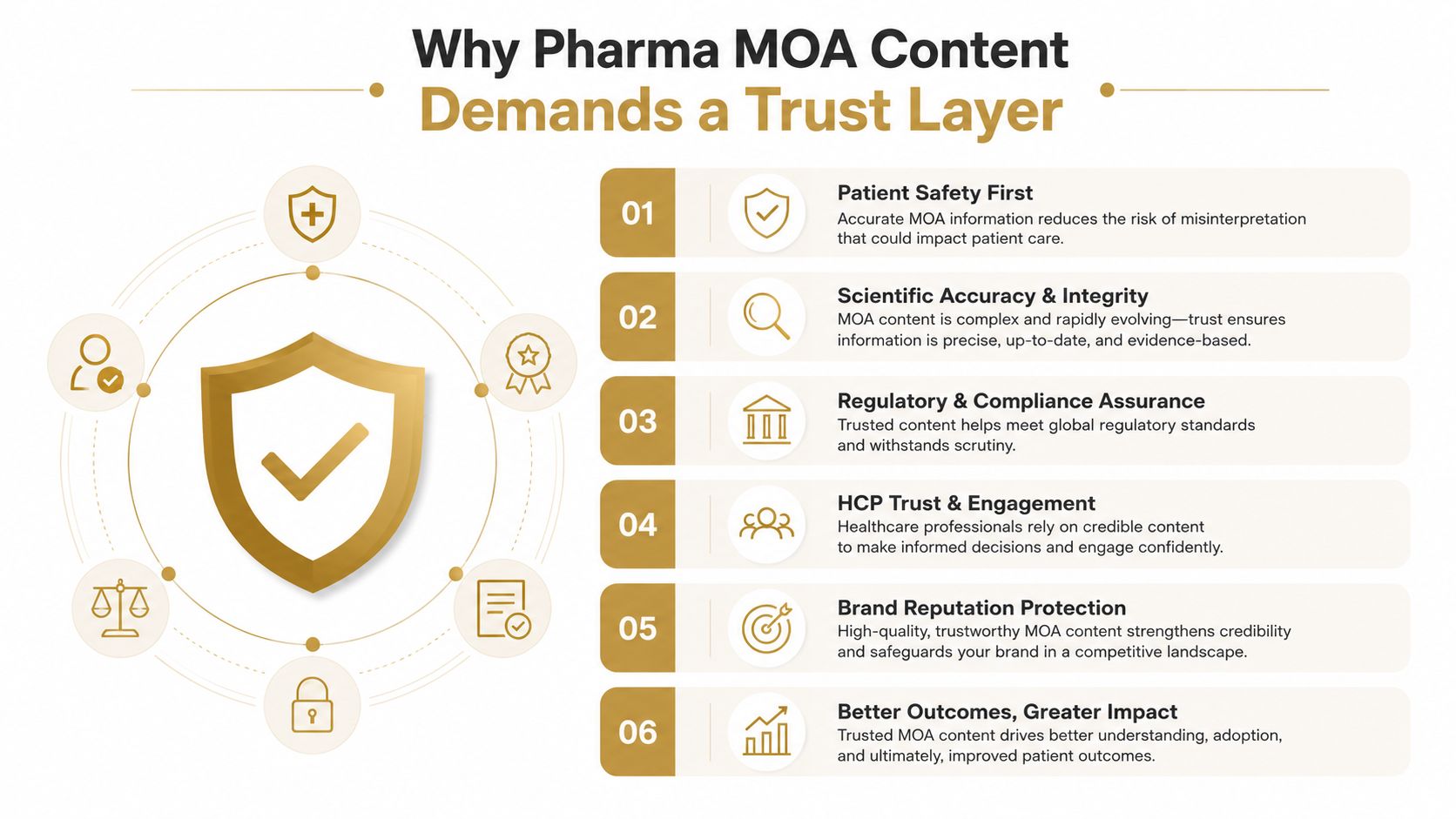
Why does Pharma MOA Content demand a Trust Layer?
Pharma MOA content is a hard test because every sentence sits under review by someone who is paid to notice ambiguity. A general marketing asset can sometimes survive on tone and clarity, but an MOA video has to withstand scientific scrutiny, internal governance, and the fact that reviewers will ask what exactly the asset is claiming.
The objections are specific
An MLR reviewer usually isn't objecting to creativity. They're objecting to ambiguity, unsupported phrasing, overreach, or terminology that sounds like a claim rather than a description. If a visual implies mechanism more strongly than the source warrants, or if a narration line compresses several biological steps into one neat statement, the reviewer has a problem.
A trust layer reduces those objections by changing the shape of the work. Evidence linking replaces unsourced claims with sentence-level citations. Explainability shows why the script chose one wording over another. Auditing creates the timestamped record that makes later reconstruction possible. Access controls keep off-label-adjacent material inside the right approval path.
Practical rule: the fewer times a reviewer has to ask, “where did this come from?”, the faster the asset moves.
That matters because MOA content tends to be reused, updated, and recontextualized. A phrase that passes today can become risky when a new indication, a revised label interpretation, or a different audience enters the picture. The trust layer has to make that evolution visible, not bury it in a static file.
What the controls solve in practice
A sentence-level citation tells the reviewer exactly what supports a line. A retrieval trace shows what the system searched and why it chose the source it did. An evidence mismatch flag catches the moment the generated text outruns the evidence. Those are the moments where rework gets prevented instead of delayed.
The deeper point is that pharma doesn't need generic chatbot usefulness. It needs evidence-linked production. In MOA work, the asset itself has to carry the proof burden because the reviewer, the medical lead, and often the field team need to know the final version is not just fluent, but defensible.
How does VarsaAI map its features to Trust Layer Controls?
VarsaAI is one concrete example of a platform built around this operating model. Its MOA workflow, sentence-level referencing, VeriCore accuracy system, The Hub content library, and compliance tooling line up with the trust layer jobs in a way that is more operational than rhetorical. It also keeps customer IP ownership with the customer, which matters because control over content and derivative assets is part of the governance boundary, not an afterthought.
The useful way to evaluate the platform is not by asking whether it uses AI. It does. The right question is which controls are runtime-enforced and which ones are just documentation claims. The difference determines whether a reviewer can trust the output or just trust the vendor.
For more on the life sciences positioning, VarsaAI's life sciences overview is the relevant place to inspect how the workflow is framed.
| Trust Layer Component | VarsaAI Feature | Control Type |
|---|---|---|
| Provenance | Data ingestion from publications and internal scientific documents, plus VeriCore validation | Runtime workflow control |
| Evidence linking | Sentence-level referencing for each scientific claim | Runtime control |
| Explainability | Claim-by-claim referencing and verification context | Runtime control |
| Verification | VeriCore scientific accuracy system | Runtime control |
| Auditing | Compliance tooling and review-ready output trail | Runtime and governance control |
| Access controls | The Hub for controlled reuse of pre-approved materials | Workflow control |
The important distinction is that these are not just policy promises. A centralized content library reduces duplicate sourcing. Sentence-level referencing reduces the burden on reviewers to reconstruct support manually. VeriCore gives the team a structured validation layer before content reaches MLR, which is where the practical value shows up.
IP ownership is worth calling out separately. If the customer retains ownership of generated assets and related outputs, the trust boundary is clearer, because the pharma team isn't forced to manage critical scientific content inside a vendor-owned black box. That doesn't remove review obligations, but it does remove one of the most common sources of uncertainty in downstream use.
How can you evaluate AI Trust Layer vendors without getting burned?
Vendor evaluation starts to look different once you stop treating trust as a slide deck theme. The key question is whether the vendor can prove control at runtime, or whether they're selling a compliance narrative wrapped around a generative workflow. That's the difference between a system you can defend and one you can only describe.
The questions that expose weak claims
Ask whether you can inspect sentence-level evidence for a disputed claim. If the answer is no, the vendor doesn't have evidence linking in a way that helps MLR. Ask whether the vendor retains your fine-tuned weights and training data. If that's negotiable, the IP boundary is softer than it should be.
Ask whether audit logs are immutable, exportable, and readable by regulators or internal QA teams. Ask whether access control is enforced inside the workflow, or only at the workspace level. The second answer is much weaker, because it doesn't stop a person from moving content through the wrong step once they already have access.
- Hallucination budget: define how much unsupported generation is allowed before the system blocks output.
- MLR-ready versioning: make sure every draft can be tied back to a specific evidence set and approval state.
- Retraining transparency: require visibility into what changed when the model, prompts, or reference corpus changed.
- Incident response: ask who responds when a claim slips through, how fast they can reconstruct it, and what records they provide.
If the vendor can't show you the evidence trail, assume the evidence trail doesn't exist in a form you can rely on.
Red flags that usually mean documentation only
Be cautious when the pitch leans on vague AI governance whitepapers instead of product behavior. Treat missing EU AI Act logging details as a serious gap, not a minor omission. And if IP ownership is presented as a later negotiation point rather than a default part of the operating model, the vendor is asking you to accept hidden risk.
The best procurement posture is defensive. You're not buying a vision statement, you're buying a system that has to survive scientific review, internal escalation, and eventual audit. If the answers stay abstract when you press on evidence, logging, access, or ownership, walk away.

Why should trust be considered a runtime discipline, not a deliverable?
Trust isn't something you finish and file away. In MOA content, it has to stay alive as the sources change, the evidence base evolves, and reviewers apply different judgment to the same claim in a different context. A signed attestation or a model card doesn't solve that problem by itself.
The better operating model is continuous. Versioned evidence references need to be rechecked when regulatory expectations shift. Sentence-level audit trails need to keep appending as assets are edited and reused. Reviewer access controls need to be re-attested on a schedule that matches the governance calendar, not the project plan.
That's the mindset shift. Deliverable thinking says the job is done when the vendor hands over the file. Runtime thinking says every MOA video remains an evidence object long after launch, and the team needs an owner for that object inside the brand or medical function. The owner doesn't need to do every task personally, but they do need to answer for the trust layer when content gets challenged.
For pharma teams, that means treating the ai trust layer as part of content operations, not as a separate compliance initiative. When the system is built that way, reviewers move faster because they can see the proof, not because they've lowered the bar.
VarsaAI builds MOA videos and related scientific content with sentence-level referencing, verification, compliance tooling, and customer IP ownership built into the workflow. If you're trying to make MLR review more defensible without slowing scientific teams down, visit VarsaAI and see how a trust-linked MOA pipeline can fit into your process.
Frequently asked questions
- What is the primary function of an AI trust layer in pharma?
The primary function of an AI trust layer in pharma is to provide a runtime control plane that ensures every scientific statement generated by an AI system is traceable, verifiable, auditable, and defensible. This helps content withstand rigorous MLR review and regulatory scrutiny.
- How does an AI trust layer differ from generic AI governance?
Generic AI governance defines what should happen, while an AI trust layer actively makes sure the system can prove what actually did happen. It also differs from model evaluation, as a well-scoring model can still produce untraceable claims in production without a trust layer.
- Why is provenance different from evidence linking in a trust layer?
Provenance identifies the origin of content (e.g., from a slide), while evidence linking provides granular support for a specific sentence (e.g., a precise publication or page). Provenance answers 'where it came from,' while evidence linking answers 'what source supports this exact sentence.'
- What role do auditing and access controls play in maintaining a defensible AI system?
Auditing creates an immutable record of content changes, sources used, and approvals, allowing for reconstruction of decisions. Access controls define who can edit, approve, or reuse content, enforcing workflow boundaries to prevent unauthorized actions and maintain defensibility.
- What are key red flags to look for when evaluating AI trust layer vendors?
Red flags include vague AI governance whitepapers instead of concrete product behavior, missing EU AI Act logging details, and treating IP ownership as a negotiable point rather than a default operating model. These often indicate a lack of runtime control and increased risk.
Add the trust layer to your LLM.
Every claim verified, every citation listed — inside your existing AI workflow.
Get pricing →