Citation Management Software: A Pharma Team’s Guide
Learn how citation management software helps pharma teams organize references, ensure compliance, and streamline collaborative research in 2026.
Citation management software in pharma helps ensure all claims are linked to verifiable sources, preventing rework and audit friction by maintaining a clear evidence trail. It acts as a digital librarian, evidence auditor, and compliance ledger, capturing source metadata, usage history, and approval status. This enables MLR reviewers to inspect evidence directly instead of investigating references.
Why is citation management software important in pharma?
A missing citation rarely looks serious when it first appears. A writer may have copied a sentence from an earlier deck, a medical writer may have changed the wording during editing, or a designer may have removed a footnote while rebuilding a slide. By the time the asset reaches MLR, the claim remains, but the evidence trail has disappeared.
That gap creates avoidable work. The reviewer has to determine whether the source exists, whether it supports the exact wording, whether the publication is current, and whether the reference was already approved in another context. If the team can't answer quickly, the reviewer has only one defensible option: flag the claim.
Practical rule: A citation that can't be traced at the sentence level is a lead, not compliance evidence.
Pharma teams should treat citation management as infrastructure connecting claims to evidence. The system needs to preserve the source PDF or record, capture relevant metadata, show where the source is used, and retain enough history to explain how the reference entered the asset. That's especially important when multiple contributors work across medical affairs, field medical, agencies, and commercial functions.
The category has evolved along with research workflows. A review of reference management tools describes how platforms moved from desktop-based libraries and manual formatting toward PDF storage, automated bibliography generation, cross-device access, and collaboration. EndNote was first released in 1988, Zotero followed in 2006, and Mendeley launched in 2008, a progression that mirrors the shift from local reference collections to connected research environments.
The commercial demand is also established. One market report values reference management software at $1.2 billion in 2023 and projects $2.8 billion by 2032, with a stated 9.8% compound annual growth rate, as reported by Dataintelo's reference management software market analysis. Those figures don't prove that any individual platform is suitable for MLR. They do show that this is a durable software category, not a temporary academic convenience.
The right question for a pharma team isn't, “Can this tool format references?” It's, “Can this tool help a reviewer verify every material claim without rebuilding the evidence trail?”
What does citation management software actually do?
Think of citation management software in three layers.
At the first layer, it's a digital librarian. It collects papers, abstracts, clinical records, and PDFs, then organizes their authors, titles, journals, dates, identifiers, notes, and attachments. It inserts references into Word or presentation workflows and formats bibliographies in styles such as AMA or JAMA.
That layer is useful, but it's the least interesting part of the product.
At the second layer, the platform becomes an evidence auditor. It associates a specific statement with a specific reference, preserves the source file, records edits to metadata, and helps users identify duplicates, broken records, or outdated evidence. A medical writer can answer the reviewer's practical question, “Which source supports this sentence?”
At the third layer, it functions as a compliance ledger. The system records who added or approved a source, when it was verified, where it has been used, and whether the reference is permitted in a particular content context. Not every consumer reference manager provides this level of governance, so teams must test the capability rather than infer it from a product brochure.
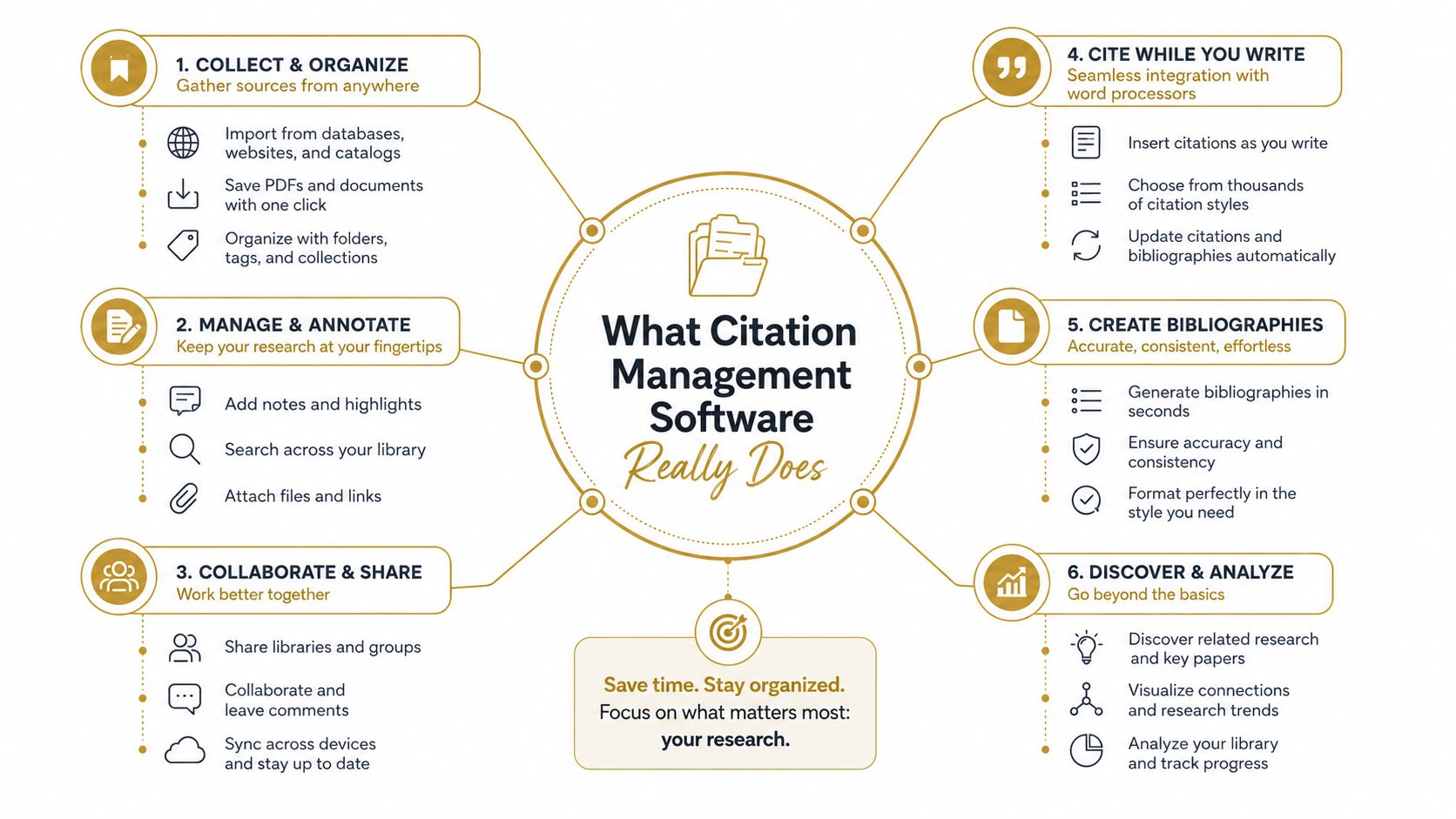
A practical reference workflow has four core jobs:
- Collect evidence: Import records from research databases, PDFs, web sources, and internal repositories.
- Organize the library: Apply tags, folders, notes, source status, therapeutic-area labels, and usage restrictions.
- Insert citations: Place references close to the claims they support and generate consistent reference lists.
- Validate records: Check metadata, duplicates, identifiers, source availability, and review status before submission.
The referencing documentation is useful as a reminder that traceable referencing depends on more than a bibliography at the end of a document. Pharma-grade deployments should add role-based access, audit trails, version history, reviewer visibility, and integrations with content and approval systems.
The critical boundary is validation. Citation software can organize and expose evidence, but it doesn't automatically make a weak source persuasive or a claim medically accurate. That distinction should shape both procurement and operating procedures.
What core workflows should every pharma team expect?
A pharma team usually feels the weakness of its reference process in four places: evidence collection, library organization, citation insertion, and validation. Each workflow produces a different MLR deliverable, and each should be tested with real assets rather than a polished vendor demo.
Collecting evidence before drafting
The input may include PubMed records, ClinicalTrials.gov entries, journal PDFs, congress abstracts, clinical study reports, internal medical summaries, and supplemental files. The tool should capture the record and preserve the associated document, rather than leaving the writer with a citation that points only to a search result.
The MLR-ready output is a central evidence record with identifiable source details, an attached file where permitted, and a status showing whether the source has been reviewed. This directly addresses the common problem of references scattered across personal folders and disconnected team repositories.
Organizing sources around claim intent
A library becomes useful when its structure reflects the work. Tags such as therapeutic area, indication, study phase, population, endpoint, safety topic, mechanism, and claim intent help reviewers understand why a source is present.
A source tagged for mechanism shouldn't support an efficacy claim without explicit justification. The tool won't make that judgment for the team, but a disciplined taxonomy makes the mismatch visible before submission.
Inserting references at sentence level
A bibliography can show that a paper exists. It can't always show which sentence it supports. For MLR, the stronger pattern is a claim linked to a source identifier, with access to the relevant document, page, table, figure, or excerpt where the evidence is located.
The expected output is a reviewer-visible connection between claim, citation, and source context. That connection reduces the familiar review comment asking which reference supports a particular statement.
Validating before approval
Validation should cover duplicate records, missing fields, broken links, inconsistent formatting, altered source details, and known publication-status issues. A citation manager can flag data problems, but human reviewers still need to assess evidence quality and claim interpretation.
The metadata problem is measurable. A comparative study found that Zotero and Mendeley extracted all 16 tested metadata fields accurately from ScienceDirect and arXiv records, while Zotero extracted 10 of 16 from Google Scholar and Mendeley extracted 7 of 16, as reported in the comparison of Zotero and Mendeley. Source selection therefore affects downstream cleanup.
| Workflow | Action | MLR Pain Point Resolved |
|---|---|---|
| Collection | Import records and preserve source files | References scattered across folders and inboxes |
| Organization | Tag sources by topic, study context, and claim intent | Reviewers can't see why a source is being used |
| Citation insertion | Link each material claim to its supporting reference | “Which claim does this reference support?” |
| Validation | Review metadata, duplicates, links, and status | Last-minute corrections and post-approval rework |
What are the use cases for citation software across medical affairs, MSL, and commercial teams?
The same citation platform serves different purposes across the organization. A medical affairs group needs depth and defensibility. An MSL team needs speed without losing provenance. A commercial launch team needs controlled reuse across channels.
Medical affairs
Medical affairs writers need to bind clinical, safety, mechanism, and disease-state claims to evidence during MLR submission. Their priority is not just rapid insertion. They need sentence-level traceability, source versions that remain stable, and an audit history showing what changed after review.
A shared library also supports consistent reuse. If an approved source is used in a scientific platform, a field deck, and an educational presentation, the team should be able to identify those relationships without relying on individual memory.
MSL teams
MSLs work under tighter time pressure. They may need to find a vetted citation for a field deck, an objection handler, or a clinical conversation aid while preserving the original source and approved context. Portability matters, including the ability to move citations into PowerPoint or connected content tools without stripping source details.
The MSL requirement is fast retrieval with provenance intact. A system that forces the user to export a bare reference and then search for the PDF later hasn't solved the field workflow.
Commercial launch teams
Commercial teams need governance across sales aids, HCP email, websites, and other channels. Their central risk is drift. A claim may be copied into a new asset, shortened for a different format, or separated from the evidence package that supported the original approval.
Commercial users therefore need locked reference sets, controlled reuse, and visibility into whether a citation is approved for the intended context. Formatting consistency matters, but it's secondary to governance.
| Team | Primary Use Case | Key Citation Requirement | Success Metric |
|---|---|---|---|
| Medical affairs | MLR submission and scientific content development | Sentence-level traceability and version history | Reviewers can verify claims without manual source hunting |
| MSL | Field decks and clinical conversation aids | Fast, portable access to vetted citations | Field materials retain source provenance during updates |
| Commercial | Reusable launch and promotional content | Controlled reference sets linked to approved claims | Teams reuse evidence without claim drift |
A single platform can support all three groups, but the configuration shouldn't be identical. Medical affairs may require the strictest source review. MSL teams may need a simpler retrieval interface. Commercial teams may need tighter permissions around reuse and channel eligibility.
How does citation software connect to MOA content platforms like VarsaAI?
In an MLR workflow, citation management should function as the evidence backbone beneath an MOA content platform. The content platform assembles scientific material. The citation layer records each claim's origin, evidence context, current status, and permitted use. That changes citation software from a bibliography formatter into compliance evidence.
The workflow begins with ingestion. Published references, clinical study outputs, internal scientific documents, and approved evidence summaries enter a controlled repository. An API or connector can make those records available inside the content environment, so writers and reviewers can work from governed evidence instead of rebuilding source trails during review.
Sentence-level referencing is the operating control. A statement about mechanism, population, endpoint, or safety should carry its citation, source version, relevant excerpt, and approval status. If a writer changes the sentence, the system should preserve that relationship or trigger review when the revised wording extends beyond the supporting evidence.

AI-assisted drafting makes this control more important. AI can assemble language quickly, but it cannot serve as the authority for source authenticity, evidence interpretation, or approval status. The recent review of citation management limitations notes that imported metadata may be incomplete or inconsistent and that major platforms reviewed lacked automatic reference validation. Pharma teams should treat those gaps as review risks.
A connected platform should constrain how evidence travels through content:
- Evidence retrieval: Bring approved sources into the drafting environment.
- Claim grounding: Link each material sentence or modular block to its supporting reference.
- Review traceability: Display the source, version, approver, and change history.
- Controlled reuse: Keep approved language attached to its evidence context.
- Validation support: Flag missing or unverified references before MLR submission.
This setup does not produce automatic approval. It gives reviewers a clearer audit trail and reduces the risk that approved claims lose their provenance as teams adapt content for new assets.
What selection criteria are important for compliance-ready citation software?
Don't select a platform because its bibliography output looks polished. Put vendors through a workflow that resembles your actual MLR process, using a difficult source mix and a real asset with known review friction.
Start with sentence-level referencing. Ask the vendor to show a claim in a slide or document, open the linked source, identify the supporting passage, and display the reference's current status. If the system can show only a numbered bibliography, it's a formatting tool, not a compliance-ready evidence layer.
Next, test the audit model. You need to know who added a source, who modified its metadata, who approved it, when verification occurred, and what happens when a source is replaced or withdrawn. Expert guidance on audit-trail review emphasizes risk-based review, independent verification, documented scope, escalation, and signed evidence, as described in this audit-trail review guidance.
A practical vendor scorecard
Evaluate each capability against your own workflow, not a generic feature list:
- Claim traceability: Does every material statement link directly to its supporting source?
- Metadata accuracy: Can the system handle journals, abstracts, clinical study reports, internal evidence, and supplemental files without hiding missing fields?
- Version control: Can users distinguish source versions and see how changes affect approved content?
- Auditability: Are approvals, changes, verification activity, and reviewer actions visible and exportable?
- Integration: Are open APIs and connectors available for MAM, Veeva, document management, and approval platforms?
- Compliance posture: Does the vendor provide documentation relevant to 21 CFR Part 11 alignment, SSO, access controls, validation, and security review?
- Reuse governance: Can administrators restrict citation reuse outside an approved context?
- Update propagation: When evidence changes, can the team identify every approved asset that may need review?

Use the source traceability guidance to sharpen the vendor discussion around claim-to-source relationships. Then score each criterion from 1 to 5, define the minimum acceptable score before the demo, and require the vendor to demonstrate the complete workflow live.
Low-resource teams should also assess licensing, training, VPN or proxy constraints, and interface complexity. A research lifecycle guide on citation management identifies collaboration, access, licensing, and training as practical considerations that can determine whether a tool works beyond an individual user.
What are common gaps and misconceptions about citation management software?
“Automated referencing” covers less than many vendor demos imply. Most tools capture records and format bibliographies. They do not prove that a reference is authentic, that its metadata is accurate, or that it supports the exact claim beside it. In MLR-ready pharma content, that distinction separates a formatted citation from usable compliance evidence.
Post-import accuracy remains a human responsibility
Metadata can arrive incomplete or inconsistent. Author lists may need correction, titles can be truncated, identifiers may be missing, and publication details can be mismatched. As noted earlier, extraction performance varies by source, so importing a record is not verification.
Require the vendor to test imperfect inputs, not only clean database records. Use PDFs, abstracts, internal documents, and records with missing identifiers. Check whether the system exposes uncertainty or presents incomplete data as final. A reviewer needs to see what requires confirmation before the citation enters an approved asset.
Provenance can disappear after capture
A citation record is not the same as evidence provenance. If the system stores only authors, title, and journal, the reviewer may still need to search a long PDF for the supporting passage. That fails the sentence-level traceability expected in regulated review.
Ask whether the platform preserves the source file, page or section context, notes, relevant excerpts, and usage history. Require a visible relationship between each claim and its supporting passage. If a writer cannot show why a claim was included, the citation is not ready for MLR.
Formatting does not validate evidence
A correctly formatted bibliography can still contain an unsuitable source, an overstated conclusion, or an off-label extrapolation. Citation software does not replace medical judgment, source appraisal, or MLR review.
The uncomfortable truth: A formatted reference list can make weak evidence look organized.
Reference validation is another common misconception. A review of major platforms identified automatic validation as a shared shortcoming, which matters more when AI-generated text enters the workflow. Teams should require a live demonstration of verification controls rather than assume the feature exists.
Use this discussion of ChatGPT citations to frame the operational question: can the system distinguish a source that exists from a source that supports the generated statement? If manual checking remains necessary, assign that responsibility in the SOP and retain the evidence of review.

How can pharma teams build a citation-ready content workflow this quarter?
Treat citation management as compliance infrastructure. The teams that wait until the next difficult review to fix their evidence process will keep paying for the same failure in rework, escalations, and delayed approvals.
Use a focused 90-day plan.
-
Weeks one to three, audit the last three MLR rejections. Tag every issue to a concrete citation gap, such as a missing source, incorrect publication detail, unlinked claim, unsupported superlative, or unclear provenance. Don't accept “citation problem” as a category. Identify the failure mode.
-
Weeks four to eight, pilot one tool against two real assets. Choose assets with different formats or review histories. Score the platform on sentence-level referencing, metadata handling, audit trails, APIs, integration with the content hub, access controls, and reviewer usability. Require the vendor to work with your evidence, not a prepared demo library.
-
Weeks nine to twelve, codify the standard. Write a citation policy that defines acceptable source types, verification responsibilities, required source attachments, approval states, and rules for reuse. Add a content template that enforces claim-level linking and create a reviewer view that exposes the evidence trail on demand.
The payoff is operational, not cosmetic. A reliable citation layer reduces the chance that a missing or altered reference will force an otherwise sound asset back through review. It also gives any MOA content platform a defensible foundation, because fast content generation without controlled evidence accelerates the production of material that reviewers can't approve.
VarsaAI combines scientific content generation with centralized evidence handling, sentence-level referencing, and controls designed for MLR-ready MOA materials. Visit VarsaAI to see how its platform can connect source data, traceable claims, and reusable pharma content in one workflow.
Frequently asked questions
- What is the primary purpose of citation management software in pharmaceutical content creation?
The primary purpose is to connect claims to their original sources, preserve the provenance of content, and provide MLR reviewers with verifiable evidence. This prevents common issues like missing citations, off-label drift, and unclear source trails that can delay content approval and lead to rework.
- How has citation management software evolved over time?
Originally desktop-based for manual formatting, these tools have advanced to include PDF storage, automated bibliography generation, cross-device access, and collaborative features. Early examples like EndNote (1988) progressed to Zotero (2006) and Mendeley (2008), reflecting a shift towards connected research environments.
- What are the three main layers of functionality in citation management software?
Citation management software functions as a digital librarian for organizing research materials, an evidence auditor for associating statements with specific references and tracking edits, and a compliance ledger for recording approvals, usage, and permitted content contexts. Not all tools offer the compliance ledger layer.
- Can citation management software automatically validate the accuracy of evidence?
No, citation management software can organize and expose evidence, but it does not automatically make a weak source persuasive or a claim medically accurate. Human reviewers are still essential for assessing evidence quality, claim interpretation, and verifying metadata accuracy after import, as tools may not always provide automatic validation.
- How can AI-assisted drafting impact the need for robust citation management?
AI can quickly generate language, but it lacks the authority to verify source authenticity or approval status. Robust citation management is crucial to ground AI-generated content in approved evidence, ensuring that claims are traceable, compliant, and supported by verified sources, rather than accelerating the production of unapprovable material.
Add the trust layer to your LLM.
Every claim verified, every citation listed — inside your existing AI workflow.
Get pricing →