Scientific Video Production: A Complete Workflow Guide
Step-by-step guide to producing MLR-ready scientific video content for pharma and life sciences, from source ingestion to compliant export and ownership.
To avoid costly revisions and delays in scientific video production, an MLR-ready workflow prioritizes traceability, scientific accuracy, and reviewability from the start. This involves selecting defensible sources, scripting with sentence-level referencing, scientifically reviewing animations, conducting accuracy checks, and packaging evidence for efficient regulatory review and controlled reuse.
Why does MLR-ready scientific video need a different workflow?
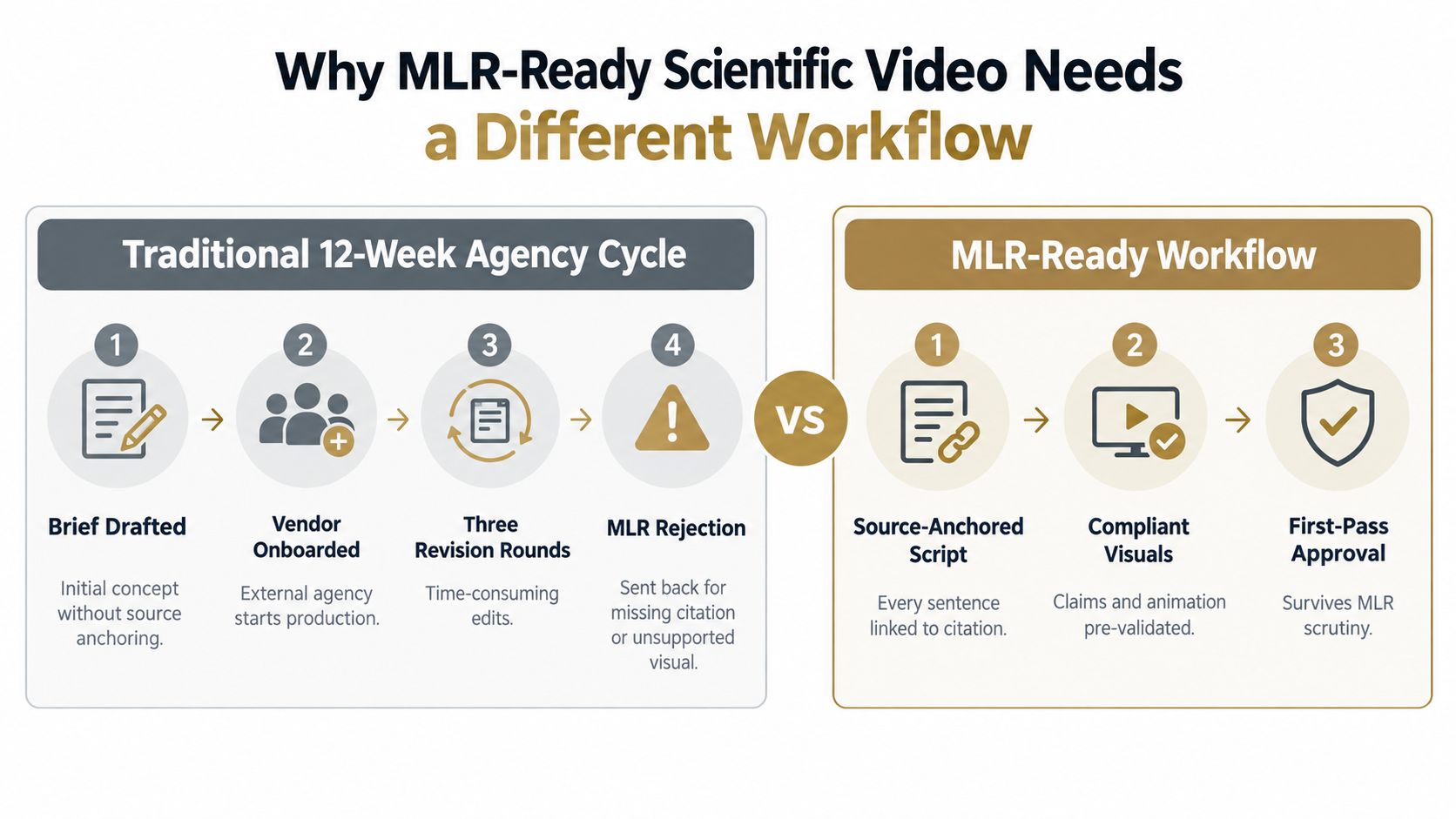
The familiar agency cycle begins with a brief, not evidence. A vendor develops the concept, production starts before the claim architecture is settled, and revisions accumulate as reviewers identify missing references or unsupported visual choices. By the time MLR sees the asset, creative decisions have become expensive to unwind.
That workflow treats compliance as a final inspection. It separates the people who create the story from the people who must defend it. An MLR-ready workflow does the opposite. It makes source selection, sentence-level referencing, visual accuracy, ownership, and submission packaging part of production rather than cleanup.
The commercial case for changing the workflow is clear. The global medical animation market, a measurable proxy for scientific video used in pharma and life sciences, was valued at USD 472.22 million in 2024 and is projected to reach USD 1,418.67 million by 2030, with a projected 20.3% CAGR from 2025 to 2030, according to Grand View Research's medical animation market analysis. Scientific video is no longer an occasional educational deliverable. Teams need a repeatable system that can support launches, updates, field education, congress use, and regional adaptation without rebuilding the evidence trail each time.
Build reviewability into every stage
The practical workflow has seven connected stages:
- Ingest defensible sources and classify them by claim relevance.
- Write a sentence-level referenced script before animation begins.
- Generate the MOA animation only from approved claims.
- Run scientific accuracy checks before submission.
- Package the evidence trail so reviewers can verify claims quickly.
- Export controlled versions with documented ownership.
- Store the canonical asset centrally for governed reuse.
Speed comes from removing rework, not from skipping review. Platforms such as AI compliance software for structured review workflows can support that operating model, but the principle matters more than the tool: a scientific video clears faster when the reviewer receives a checkable audit trail instead of a finished file surrounded by unanswered questions.
How are scientific sources selected and ingested?
The first production decision is not the animation style. It's the evidence boundary. Before anyone writes narration, decide which sources can support the claims and which documents should remain background context only.
Start with primary, authoritative materials:
- Peer-reviewed publications: Use the original paper whenever possible, not a later article that summarizes it.
- Clinical trial evidence: Preserve the protocol, results, population, endpoints, and relevant analyses together.
- Approved prescribing information: Treat the current label as the controlling source for indication, dosing, administration, limitations, and safety language.
- Internal scientific narratives: Include approved medical or scientific documents when they add context that external literature doesn't provide.
Exclude materials that create ambiguity. Preprints without the required endorsement, secondary citations, promotional copy, and unapproved messaging shouldn't become the foundation of a reviewable script. A marketing statement may be directionally accurate, but directionally accurate isn't sufficient when a reviewer asks which study supports the exact wording on screen.
Ingest for retrieval, not storage
A folder full of PDFs isn't an evidence system. Each source should enter a structured workspace with metadata that helps the team retrieve it later. Tag the therapeutic area, trial phase, document type, version, date, population, and claim categories such as efficacy, safety, mechanism, pharmacology, or disease biology.
That classification changes the work downstream. When a writer drafts a mechanism sentence, the workspace should surface the relevant source set instead of forcing someone to search every document manually. When a reviewer challenges a safety statement, the team should be able to identify the source, section, page, and applicable population without reconstructing the project history.
Practical rule: If a source can't be found and interpreted quickly by someone who didn't create the project, it hasn't been ingested properly.
Control versions aggressively
Living documents need explicit version control. Investigator brochures, labels, internal narratives, and study summaries can change, so record the version used for each script and retain superseded files rather than replacing them. The asset record should show which document supported the approved claim and whether a later update requires reassessment.
This ingestion stage is where many projects fail. The files exist, but nobody has mapped them to claim types, versions, or intended uses. MLR then receives a video that looks complete while the underlying evidence map is incomplete. Fix that before scripting, when source decisions are still cheap.
How does sentence-level referencing work in scripting?
A reviewable script uses one sentence for one scientific assertion. That discipline sounds simple, but it prevents the compound claims that create most citation disputes.
Write each sentence on its own line. Keep the register plain and precise. Avoid stacking mechanism, efficacy, and safety into a single statement that would require several sources and several different qualifiers.
For example, a sentence describing receptor binding should not also claim downstream clinical benefit unless the evidence supports both parts. Separate them, reference them separately, and let the visual treatment follow the distinction.
Attach the evidence while writing
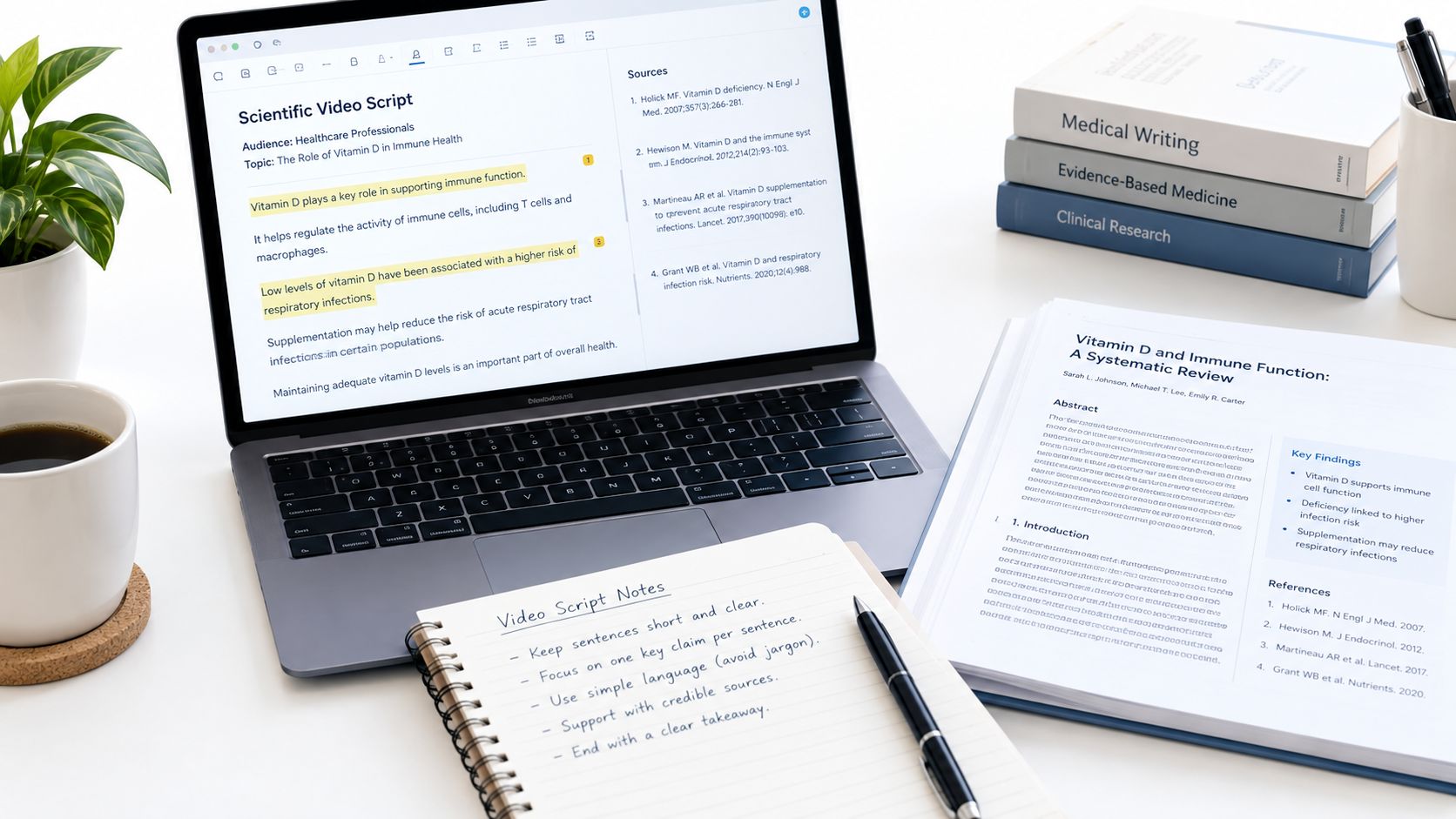
Each sentence should carry an inline reference to the source, relevant section, and exact page or figure. A reviewer shouldn't have to search a paragraph footnote, open several documents, and guess which passage supports which phrase.
A useful script record contains:
- Narration: The exact spoken sentence.
- Claim type: Mechanism, efficacy, safety, disease biology, or another defined category.
- Source: The publication, label, protocol, or approved internal document.
- Location: Section, page, table, or figure.
- Review status: Draft, Medical Affairs approved, or flagged for escalation.
- Visual instruction: What the viewer will see while the sentence plays.
This is different from adding references after the creative draft is finished. Retrofitted references often expose wording that the source doesn't support. Sentence-level linking forces the writer to resolve that mismatch before animation begins.
Write like the source, not the sales deck
Mirror the publication's precision. If the study reports an association, don't rewrite it as causation. If the population is limited, preserve that limitation. If a result applies to a specific endpoint, don't broaden it into a general efficacy statement.
Compound claims deserve special handling. Either split them into separate sentences or attach every supporting source and mark the sentence for Medical Affairs review. A sentence that requires judgment should be visible as a judgment point, not hidden inside a polished paragraph.
The sentence-level referencing documentation reflects the right operating principle: reviewers should be able to move from a claim to its evidence without ambiguity. That traceability turns MLR review from an open-ended negotiation into a finite audit trail.
How is the MOA animation generated?
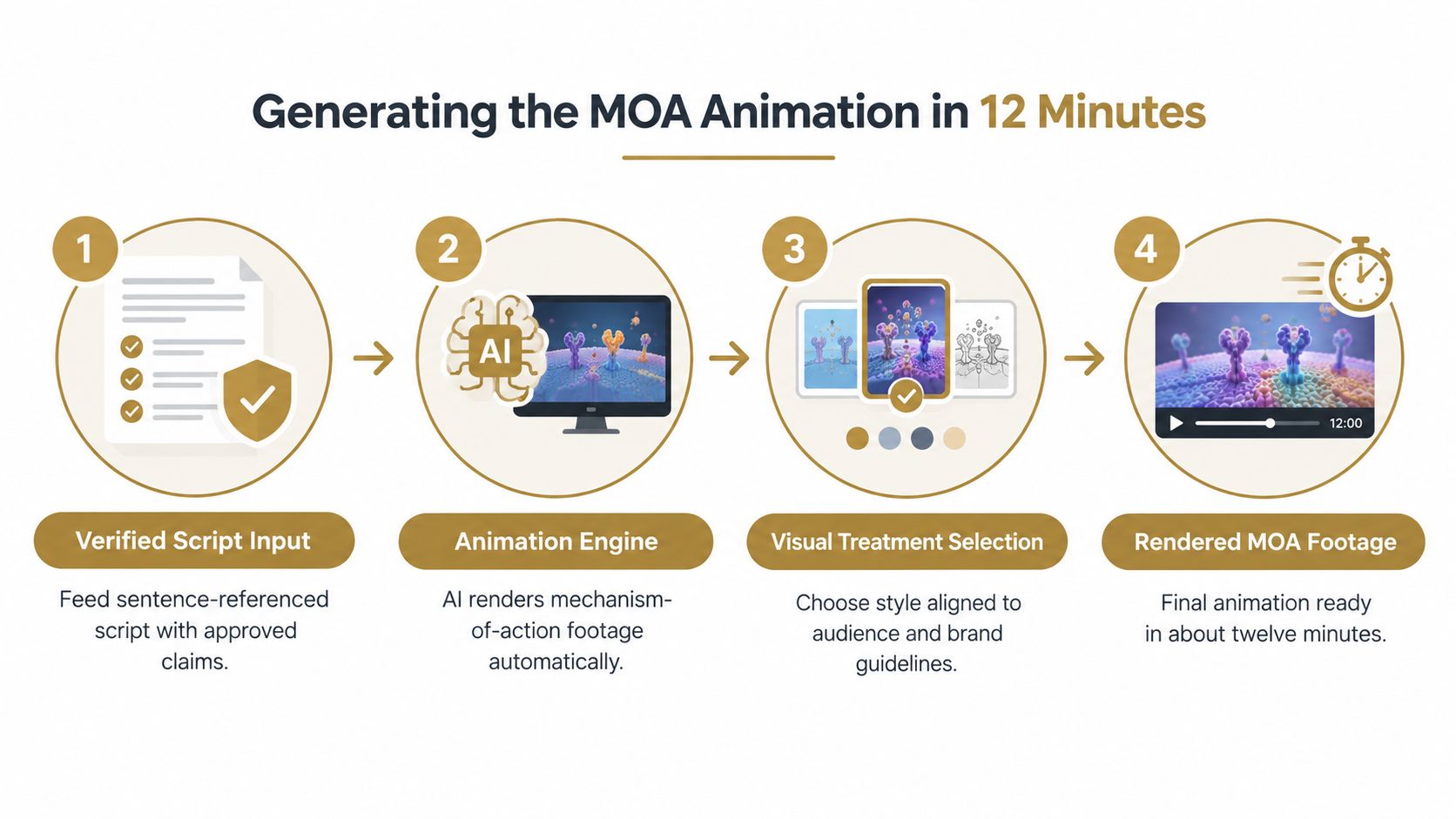
Once the script is verified, animation becomes a translation task. The system should convert each approved sentence into a corresponding molecular, cellular, or disease-process event rather than inventing visual detail to make the video feel more dramatic.
VarsaAI describes a workflow that can generate MOA footage in approximately 12 minutes, based on a verified script and selected visual treatment. The timing is useful only if the evidence gate comes first. Fast rendering of an unsupported claim produces rework faster.
Review the first cut scientifically
Don't begin with color, music, or camera movement. Check whether the visual says exactly what the narration says.
Review the first cut for:
- Molecular orientation: Confirm ligand, receptor, enzyme, antibody, and substrate relationships.
- Pathway logic: Ensure arrows and sequence reflect the stated biology.
- Color consistency: Use one visual code for each pathway or entity throughout the asset.
- Kinetics and duration: Flag visuals that imply speed, persistence, saturation, or magnitude not supported by the script.
- Population and indication boundaries: Keep the animation from suggesting use outside the evidence or approved context.
- Data representation: Ensure charts, scales, and comparisons don't imply an unmeasured outcome.
If a visual needs to communicate information that the script doesn't state, revise the script first. Don't let the animator add a new scientific claim through imagery. The approval standard is sentence-to-scene alignment. Every narrated assertion should have a visual counterpart, and every meaningful visual assertion should have a referenced sentence.
For teams evaluating an AI trust layer for scientific content, the key question is not whether the output looks realistic. Ask whether the system preserves the evidence boundary as it moves from source to script to scene.
How are scientific accuracy checks performed with VeriCore?
A polished cut can still contain scientific drift. Paraphrases become stronger than the source, labels disappear from on-screen text, and visual shorthand can imply a result that the study never examined. Accuracy checks must therefore evaluate the whole asset, not just the manuscript.
VeriCore is described as a scientific accuracy layer that cross-references tagged sentences against the ingested source corpus. Its role is to identify missing citations, wording drift, overstatement, and mismatches between the claim and the source. That makes it a pre-MLR control, not a substitute for Medical Affairs judgment.
Use evidence triage before final review
A 2026 quality-improvement study of 309 video medical claims found that 62.5% of claims had very low or no supporting evidence, while only 19.7% were backed by high-quality evidence, as reported in the study published in PMC. The operational lesson is direct: don't assume a physician presenter, confident narration, or strong engagement makes a claim scientifically reliable.
The same study found that weaker-evidence videos attracted more views than stronger-evidence videos. Engagement can therefore create a dangerous false signal. A video may perform well and still fail the standard required for an approvable scientific asset.
Run a pre-MLR checklist that tests:
- Claim support: Every MOA step maps to a peer-reviewed or approved internal source.
- Label alignment: Indication, dose, population, and safety wording match the current approved label or applicable study protocol.
- Endpoint accuracy: The narration preserves the endpoint measured.
- Comparator balance: Comparative language identifies the appropriate comparator and avoids unsupported superiority.
- Visual restraint: No scene implies an unstudied outcome, duration, magnitude, or patient benefit.
- Reference completeness: Every sentence and meaningful on-screen statement has a traceable citation.
Capture the VeriCore accuracy report as a PDF and attach it to the asset record. Reviewers should be able to see which claims passed, which were revised, and which require human sign-off. The system narrows the questions. Medical Affairs still owns the scientific decision.
How is the asset prepared for MLR review?
MLR reviewers shouldn't have to assemble the evidence package themselves. Give them a single submission folder that lets them move from the rendered video to the exact claim, source passage, and review decision without searching across email threads or vendor portals.
The core package should include the final render, a time-coded transcript with inline citations, the VeriCore report, the source dossier, and a claim-evidence matrix. Add the completed MLR form with intended audience, distribution channels, fair-balance language, asset metadata, and expiry information tied to the most recent cited publication or governing document.
Make the matrix time-based
Organize the claim-evidence matrix by video second rather than by document order. Reviewers experience the asset as a timeline, so the evidence package should follow that same path.
| Artifact | Purpose |
|---|---|
| Rendered MOA video | Gives reviewers the exact asset under review |
| Time-coded transcript | Shows every spoken sentence at its point in the video |
| Inline citations | Connects each sentence to a source and location |
| Claim-evidence matrix | Maps narration and on-screen claims by video second |
| Source dossier | Provides the publications, labels, protocols, and internal documents |
| VeriCore accuracy report | Records automated checks, flags, and resolutions |
| MLR submission form | Defines audience, channels, metadata, balance, and expiry |
| Reviewer note | Highlights off-label discussion, comparator framing, and safety nuance |
A one-page reviewer note is particularly valuable when the content contains a judgment point. Call out any off-label discussion, comparator limitation, safety nuance, or visual simplification before the reviewer has to discover it. Transparency reduces suspicion and directs attention to the places where human expertise matters most.
Submit one controlled record
Use a centralized hub with read-only reviewer access. Keep the submitted files together, lock the version under review, and maintain a clear change log for later edits. Don't send a video in one message, references in another, and a corrected transcript in a third.
A video-based health education review found that format and learning objective matter, with knowledge and skills outcomes varying by discipline. The systematic review and meta-analysis supports a practical distinction: a knowledge-transfer asset needs concise sequencing and explicit labels, while a skills-focused asset needs procedural steps and decision points. That distinction belongs in the submission note because reviewers need to understand what the video is designed to teach.
The package should make approval a confirmation task. If reviewers must perform evidence archaeology, the workflow has already failed.
How are export, IP ownership, and reuse managed through a centralized hub?
Approval isn't the end of governance. It's the point where teams often lose control by exporting multiple versions, handing files to affiliates, or commissioning derivative cuts without preserving the original evidence trail.
Create one canonical master file and document ownership before reuse begins. For field playback, export MP4 using H.264. Preserve ProRes for broadcast or congress loops, and retain the editable project file so a controlled update doesn't require rebuilding the asset from its sources.
Preserve the source of truth
The centralized record should contain:
- The approved rendered video.
- The editable project file.
- The final script with sentence-level references.
- The source PDFs and document versions.
- The VeriCore accuracy report.
- The MLR approval receipt and change history.
- Derivative assets and their approval status.
This structure prevents version drift. An affiliate shouldn't have to ask which animation is current, whether a safety sentence changed, or why a particular receptor interaction appears on screen. The record should answer those questions.
Set IP terms at intake, not after production. Confirm who owns the master, who may edit it, whether the customer receives the editable project file, and whether the platform retains any commercial rights. For pharma teams, customer ownership should be the default requirement. VarsaAI states that its platform keeps IP with the client and treats each project as the client's proprietary asset. Document that position contractually rather than relying on an informal understanding.

Reuse the approved evidence trail
Derivative work should start from the approved script and source record. A short sales cut, regional language version, or congress loop may change duration, narration, layout, or channel specifications, but it shouldn't create a new scientific narrative by accident.
Use the original claim IDs and references for every derivative. Where the cut removes context, check whether fair balance or a limitation has also been removed. Where translation changes phrasing, route the localized text through the same scientific and regulatory controls.
A central hub makes lineage visible across channels. It also supports controlled reuse when the evidence changes. If a label update or new publication affects a claim, the team can identify every dependent asset instead of discovering the problem through an affiliate's outdated presentation.
Scientific video is now a scaling content format. One industry forecast valued the medical animation market at USD 316.11 million in 2022 and projected USD 2.35 billion by 2033, while another forecast estimated USD 429.48 million in 2024 and USD 2,102.36 million by 2033, as summarized by Straits Research. The forecasts differ, but both point to the same operating requirement: teams need governance that scales with output.
Build the workflow around evidence, not aesthetics. Choose an AI production platform only after confirming source ingestion, sentence-level references, scientific validation, MLR packaging, export control, and customer IP ownership. VarsaAI offers those capabilities for pharma and life sciences teams creating MOA videos and related scientific content. Visit VarsaAI to evaluate whether its workflow can help your team move from source documents to controlled, review-ready scientific video without repeating the agency rework cycle.
Frequently asked questions
- What is the primary difference between a traditional and an MLR-ready scientific video workflow?
A traditional workflow treats compliance as a final inspection, often leading to costly revisions. An MLR-ready workflow integrates source selection, sentence-level referencing, visual accuracy, ownership, and submission packaging into every production stage, ensuring continuous reviewability and scientific integrity from the outset.
- What types of scientific sources are considered primary and authoritative for video production?
Primary authoritative sources include peer-reviewed publications (original papers), clinical trial evidence (protocols, results), approved prescribing information (current label), and internal scientific narratives that add context not found in external literature. These ensure foundational accuracy for claims.
- What is the purpose of an evidence triage before final MLR review?
Evidence triage, aided by tools like VeriCore, identifies missing citations, wording drift, overstatements, and mismatches between claims and sources before MLR. This pre-screening acts as a control to narrow review questions, ensuring scientific reliability and faster approval.
- What elements should be included in the MLR submission package for a scientific video?
The MLR submission package should contain the final video, a time-coded transcript with inline citations, an accuracy report, the source dossier, a claim-evidence matrix, and the completed MLR form with metadata. A reviewer note can also highlight judgment points.
- Why is it important to preserve a canonical master file and document IP ownership for scientific videos?
Preserving a canonical master file and documenting IP ownership prevents version drift and ensures traceability for all derivative assets. It helps manage updates, maintain consistency across channels, and quickly identify all dependent assets if underlying evidence changes, retaining control over the scientific narrative.
Add the trust layer to your LLM.
Every claim verified, every citation listed — inside your existing AI workflow.
Get pricing →